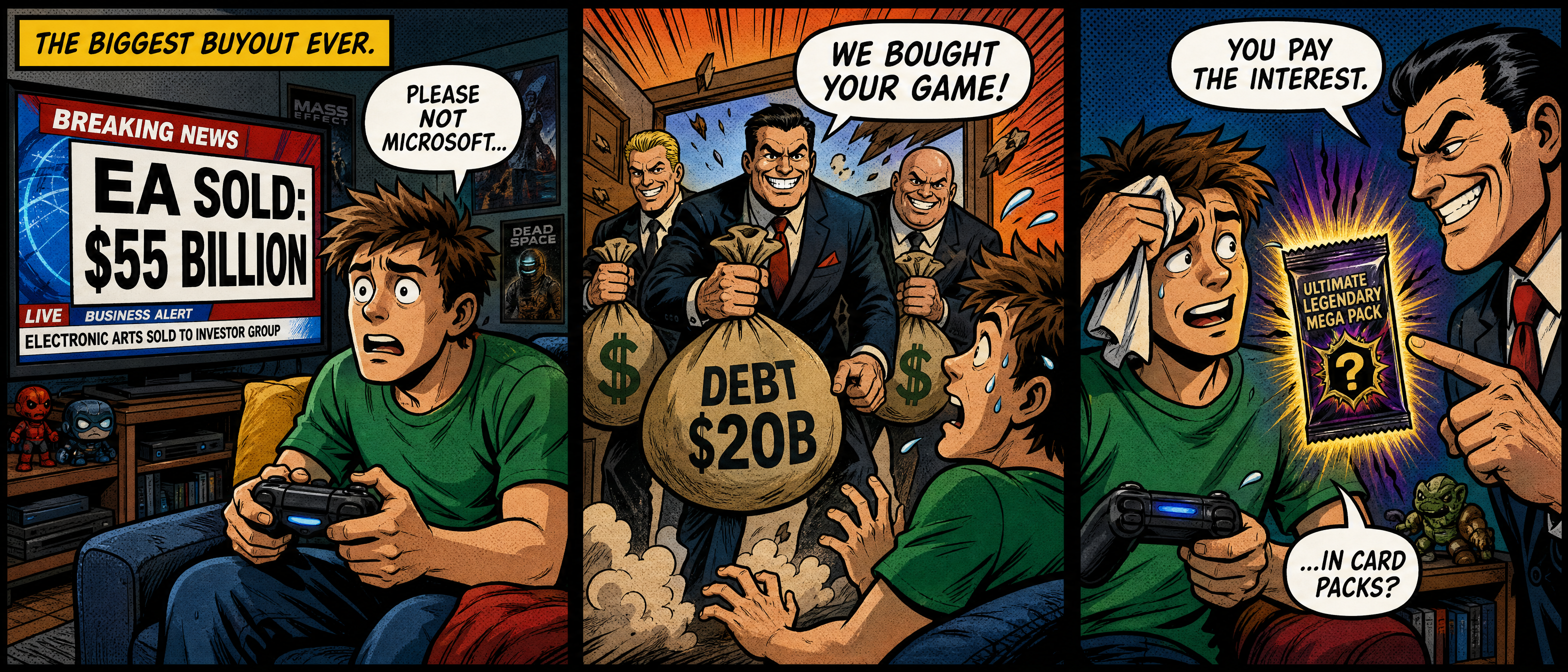
Yesterday, at the close of trading in New York, Electronic Arts stopped being a public company. I read it this morning over coffee at my desk in Germany, the same way I've read every big gaming acquisition of the last decade, and my first reaction was honestly just relief that the buyer's name wasn't Microsoft.
Then I read the deal structure and the relief got complicated.
The numbers, because they're absurd
The consortium that now owns EA is Saudi Arabia's Public Investment Fund as majority owner, Silver Lake, and Jared Kushner's Affinity Partners. Shareholders got $210 per share, a 25 percent premium, valuing EA at roughly 55 billion dollars. That makes it the largest leveraged buyout ever, past the TXU deal that held the record since 2007.
The financing is the part worth staring at. About 36 billion of it is equity from the consortium. The other 20 billion is debt, committed by JPMorgan alone, which is an unusually concentrated bet for one bank. By March, JPMorgan was already shifting more of that financing toward junk bonds.
Andrew Wilson stays on as CEO. The company stays in Redwood City. EA says the takeover won't cause "immediate" layoffs, and the word immediate is doing a lot of quiet work in that sentence.
Small admission: I expected CFIUS to drag this thing deep into 2027. It cleared in July. I was flat wrong about the timeline, which is worth remembering next time I feel confident about regulators.
At least it wasn't Microsoft
Here's the thing I actually want to say out loud, because I've been saying it to friends for months. The gaming industry has spent the last few years consolidating into three or four platform giants, and every time a big publisher wobbles, the default assumption is that Microsoft or Tencent swallows it.
We've seen how that movie goes. Microsoft closed the 68.7 billion dollar Activision Blizzard deal in 2023 and then cut 1,900 gaming jobs within three months, followed by 9,000 more company-wide in mid 2025, with canceled games and a shuttered studio in the mix. A former FTC chair got to publicly say I told you so.
So yes, a part of me is genuinely glad EA didn't become another tile in Game Pass. One fewer studio catalog absorbed into a subscription flywheel, one fewer round of "increasing agility and effectiveness".
But I want to be honest about what the alternative is, because it isn't a charity.
The debt plays FC Ultimate Team now
A leveraged buyout means the company pays for its own purchase. Those 20 billion dollars don't sit on JPMorgan's books as a favor, they sit on EA's, and analysts are already writing about how that burden will shape the games.
EA has exactly one machine reliable enough to service debt like that, and it's the one in my own house. I've bought the football game every single year since FIFA 98, and I have spent money in Ultimate Team that I will not itemize here (my wife reads this blog). That mode, plus Madden and The Sims, is the cash flow the whole deal is underwritten on.
So here's my opinion, stated plainly: the interest payments on the largest buyout in history will be collected in card packs. Monetization pressure doesn't announce itself in a press release. It shows up as slightly worse pack odds, slightly pushier storefronts, one more battle pass tier, and it lands on players who never read a word about junk bonds.
Who actually bought this
Worth remembering that PIF wasn't new here. Through Savvy Games and other vehicles it already owned stakes across Nintendo and Capcom and had been buying up gaming assets for years, and US lawmakers and union leaders objected to this deal on geopolitical grounds before it cleared anyway. The culture-washing criticism is real and I don't intend to wave it away just because the buyer wasn't a tech giant. A sovereign wealth fund buying the studio that makes the world's most popular sports game is a soft-power purchase, whatever else it is.
And the optimist case exists too, I'll grant it. A private EA doesn't have to perform for a quarterly earnings call anymore. No more explaining a delayed game to analysts. In theory that's room for longer bets and weirder projects, the stuff public-market EA slowly stopped doing. LBO history says the theory rarely survives contact with the interest schedule, but I'd love to be wrong twice in one post.
The first FC that ships fully under the new owners will tell us which way this goes. I'll buy it, obviously, I've bought 27 of them. This time I'll be reading the pack odds like a balance sheet.