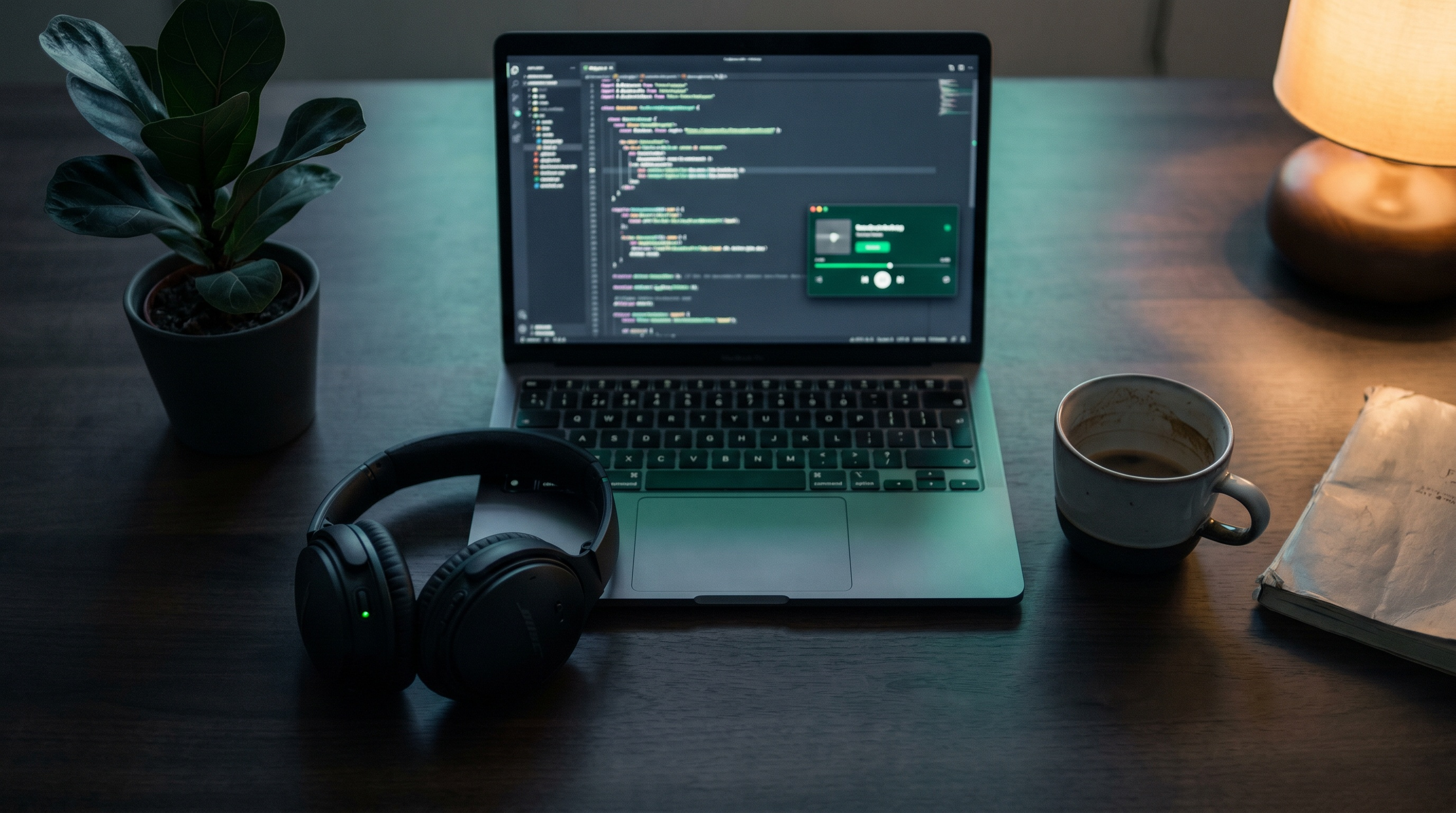
It is 22:14 on a Friday. I am in a Claude session, half-debating with the agent about whether a particular abstraction is worth it, and in the background Spotify is playing a remix of a song I would, in any other context, be slightly embarrassed to admit I like. I did not queue it. The algorithm did. I have been at this for quite a while now and have not noticed the time pass, and that is at least half the playlist's fault. Time just flies while listening to music. The other half is Claude. But Claude only gets to do its thing because the music is doing its thing first. We never talk about this part of the job. Which is strange, because we talk about every other part of it.
...We never thank Youtube Music, Spotify or similar for the producitivy gains either!
The quiet productivity engine of the internet
I want to make an unfashionable argument. A meaningful portion of the work currently being shipped by the global knowledge economy is being held together by a handful of music and video streaming services, and we owe them more credit than we give them.
Look at the data. A Qualtrics survey of software engineers put a hard number on the habit. 96 percent of software engineers report listening to music at least some of the time while coding, and 78 percent actively prefer music to anything else when they are working. For engineers under 35, that climbs to 71 percent listening very often or always. This is not a quirky habit. It is the default working condition of an entire profession.
The macro numbers back it up. Spotify just crossed 751 million monthly active users in Q4 2025, with 290 million paying subscribers and an average of 148 minutes of listening per user per day. Usage peaks between 4 p.m. and 7 p.m., the deep-work, end-of-week stretch for half the white-collar workforce on Earth. That is not all commuting. A lot of it is people closing tickets.
If you tried to put a number on the productivity delta these services provide, it would be enormous. And absolutely none of it sits in a finance category called productivity.
The Netflix-in-a-small-window people
There is a subculture I want to call out here, because I am still part of it.
Some of the most productive engineers I have ever worked with code with Netflix or a YouTube essay running in a tiny window in the corner. Not really watching. Not really listening. Just letting it murmur. I do this every day. I used to think it was a personal red flag of mine. If I need a sitcom in the background to write a CRUD endpoint, am I cooked? The answer turned out to be no. The answer is that some brains, including mine, need a low-grade competing stream of input to actually settle into the work.
I will not pretend the research is fully on my side. The studies on music and complex coding tasks generally find that music helps creative or repetitive work and can hurt heavy working-memory tasks. Lyrics-heavy songs are worse for writing prose. Familiar instrumentals are better for debugging. Brain.fm, lo-fi streams, generative ambient tools have all built businesses on the back of that nuance.
But the nuance is exactly the point. Knowledge workers have, mostly without any guidance from their employers, figured out a personal audio stack that works for them. They tune it. They protect it. When the wifi drops and the music stops, a lot of us simply get up and walk away from the laptop, because the work cannot happen without the sound.
That is a productivity tool. We just refuse to call it one.
Thank you to the algorithms
So this is the part of the post where I get unironic about it.
Thank you to whoever curated my Discover Weekly this week. Thank you to the YouTube algorithm for the four-hour history-of-aviation video that got me through last Tuesday's migration. Thank you to the lo-fi girl, who I assume is now richer than most of us. Thank you to the Netflix product team for making picture-in-picture not too intrusive. Thank you to whichever Spotify ML engineer keeps figuring out which song I need next.
Collectively, you are one of the most important and least credited productivity stacks of my career. The fact that you are filed under "leisure" on the company budget, right next to the office snacks, is one of the more entertaining accounting fictions of modern work.
I know the easy critique. But Spotify, the company, has issues. The royalties. The AI-generated playlist filler. The podcasts you wish they had not paid for. All true. Important conversations. None of them invalidate the basic fact that, on a pure infrastructure level, this service is keeping me in the chair for a meaningful percentage of every working week. The right response to a flawed service that does something useful is to push it to be better, not to pretend it is not doing the useful thing.
And while we are at it, companies should pay for it
Once you accept that streaming services are a real productivity tool, you arrive at a slightly awkward corollary....Companies should be paying for them.
Open the benefits package of any decent tech company in 2026. There is always a generous list. Gym membership or Gympass. Headspace or Calm or Lyra. Therapy reimbursement. Ergonomic chair allowance. Standing desk allowance. Noise-cancelling headphones budget. AirPods Max if you are at the right kind of company. Annual eye exams. Sleep tracker discounts. A stipend for a home office plant.
It is a long list and it is not nothing. I have personally benefited from most of those at one company or another, and I am grateful for it.
What is conspicuously absent from every benefits package I have ever seen is the one thing the headphones are actually plugged into.
A Spotify Family plan costs about seventeen dollars a month. Apple Music Premium is around eleven. Even a YouTube Premium subscription, to spare your engineers the four-minute ad block in the middle of their lo-fi stream, is roughly the same. Compared to the rest of the benefits stack, the cost is rounding error. The honest impact is bigger than half of what is already on the list.
Nobody does this. I have asked. There is always some accounting reason it would be a pain. Personal use, taxable benefit, blah blah. But every time the topic comes up, the resistance is not really practical. It is cultural. Streaming services feel too fun, too personal, too domestic, to qualify as professional spend. Which is a tell. The same logic kept companies refusing to pay for home office furniture until COVID forced their hand, and the same logic will probably break here too, eventually.
We always forget the obvious
This is the part that genuinely fascinates me.
When companies look for ways to make their people more productive, they reach for the abstract before the concrete. They will roll out a meditation app, run a mindfulness workshop, change the lunch policy, redesign the office, hire a productivity coach, sign a new project management tool, schedule company offsites in the Algarve. All of this is fine. Some of it works. Most of it is well-intentioned.
Meanwhile, the thing 96 percent of the staff is already using every day to actually do their job sits right there, costing about ten dollars a month, and nobody reimburses it.
I think we have a real blind spot around obvious things. We discount them because they do not feel sophisticated enough to be the answer. A music subscription is not a "wellness initiative." It does not get its own slide in the all-hands. There is no vendor account manager taking the People team to lunch about it. So it stays invisible, even as it carries a huge portion of the actual output.
The same applies to a lot of other quiet infrastructure. Good lighting. Decent coffee at home. A second monitor you actually want to look at. Wired internet. A door that closes. None of these get a benefits line item, but every single one of them moves productivity more than the average wellness webinar.
Companies will spend two grand a year on a fitness benefit nobody uses, then refuse to spend a hundred and twenty on a music service literally every engineer is already paying for.
So, genuinely, thank you
I am writing this as a small public correction to the way we account for productivity at work.
The next time you ship a feature on a Thursday night and you cannot quite explain why this Thursday felt easier than the last one, take a second to notice what is playing in your ears. It is probably part of the answer. The IDE got the credit. The agent got the credit. The coffee got the credit. The thing actually keeping your nervous system at the right level of arousal got none of it.
Spotify is not perfect. Neither is YouTube. Neither is Netflix. But on a quiet, ambient, week-after-week basis, they are doing more for my output than any productivity tool I have ever paid for myself. The least I can do is say it out loud.
Anyway. The playlist just queued one of my absolute favorites...back to the zone!