Every few weeks the same conversation comes back around. Someone posts about the Cloud Act, or US data access, or why we in Europe keep handing our entire digital lives to American companies. And within a few replies, like clockwork, someone drops the list. Use Nextcloud. Use Proton. Use Matrix. Self-host Mattermost. The alternatives, right there, problem apparently solved.
Then nothing moves. The thread ends, everyone goes back to Slack and Discord and Gmail and Drive, and we run the whole ritual again next month.
So the interesting question was never "do the alternatives exist." They do. It's why the mindshare never follows them.
The alternatives are real, and that's the confusing part
The standard line is "Europe has no answer to the American tech stack." That hasn't been true for years.
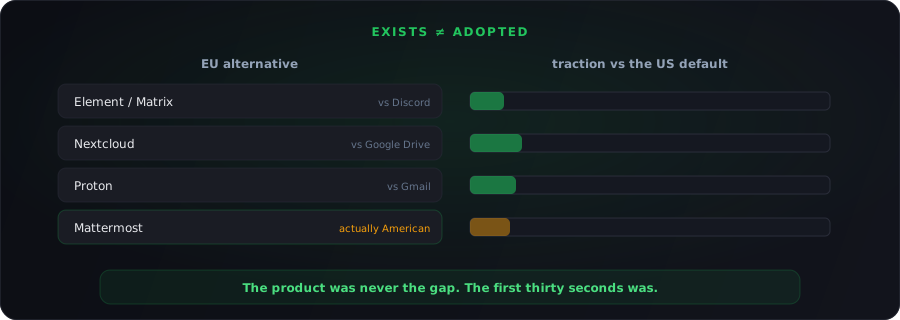
You want a Google Drive replacement? Nextcloud is German, mature, and already runs inside German hospitals, French schools, and several European governments. You want an encrypted Gmail and calendar? Proton is Swiss and has over 100 million accounts. Discord and Slack have real open alternatives in Element and Matrix, which came out of the UK. There's a privacy-first option for almost every box in the US productivity stack at this point.
So the products are there. The traction is the part that never shows up.
Quick detour, because it's telling. The app people reflexively name as "the European Slack" is Mattermost. Mattermost is headquartered in Palo Alto. It's a great open-source product and you can absolutely self-host it inside the EU, but the company is as American as Slack is.
Open source is not a sovereignty strategy
This is the part the sovereignty crowd keeps skipping, and it's the one I want people to actually sit with.
"It's open source, just host it yourself" sounds like an answer. It isn't. Open source and sovereign are two different things, and treating them as the same one quietly excludes most of the companies who'd benefit from a real European option.
Self-hosting means somebody runs the server. Patches it. Secures it. Backs it up. Watches the uptime, rotates the certs, handles the 2am outage. That's not a checkbox, that's a job, and usually more than one. A government department can do it because it has an IT division. A 5,000-person enterprise can do it because it has a platform team. Fine.
Now picture the company that most needs to get off the US stack. It's small. It's growing. It has maybe a dozen people and a product to ship, and not one of them has a spare week to stand up and babysit a chat server. Telling that company "well, it's open source, just host it" is the same as telling it "stay on Slack." They will, every single time, because they have to.
So the open-source answer sorts sovereignty into a privilege of the already-large. The orgs with their own data centers get to be sovereign. The startup with eight people and a runway clock does not. That's exactly backwards from where the energy and the growth in Europe actually is.
What a growth company needs is not source code it can theoretically host. It needs a working equivalent. A hosted, managed, sign-up-and-go European product that is sovereign because of where the company and its servers sit, not because you volunteered to become a part-time infrastructure team. Until the alternative is something you can start using in the next ten minutes with a card and no ops project attached, "we're open source" is not competing with Slack. It's competing with a weekend you don't have.
The apps aren't worse. The market under them is.
The easy explanation is that the European apps are just clunky and behind. That's mostly a stereotype now, and it's not what's actually holding them back.
If you want the structural version, Columbia law professor Anu Bradford studied exactly why European tech lags and found that regulation is not the main culprit. The real drags are a fragmented market, weak access to scale-up capital, punishing bankruptcy laws, and trouble attracting global talent. Brussels didn't ban a feature. The market never handed these companies the runway American ones get for free.
A US app is born into a market of 340 million people. A German one is born into Germany.
This is the piece that doesn't come up when people argue about privacy.
When a founder ships a consumer app in San Francisco, the home market is the entire United States. One language, one currency, one set of rules, one payment culture, 340 million people who can all use the thing on day one. Get a little traction there and you already have a base most of the world would kill for.
A founder in Munich ships into Germany. Then France, which is a different language, different habits, often extra national rules layered on the EU baseline. Then Italy. Then Poland. The "single market" is, in practice, 27 markets stitched together, with over 100 different VAT rates and national rules gold-plated on top of the EU ones. Compliance costs for European startups can run roughly double what a US startup pays. English proficiency drops below 50 percent across big parts of southern and eastern Europe, so "just ship it in English" quietly cuts your real market by a third.
The American app gets a head start measured in users. The European one spends that same window doing translation and tax paperwork. By the time the EU app is presentable across five countries, the US one is the global default and everyone's team is already inside it.
Then there's the money, which is not close
Even a great product needs fuel to chase that default, and this is where it gets bleak.
In 2024, venture investment into European startups was about 52 billion dollars for the whole continent. The US deployed several times that. Stretch it out and the gap turns cartoonish. From 2013 to 2022, US-headquartered firms pulled in roughly 1.4 trillion dollars more venture capital than European ones. Not a typo. Trillion.
That money (and it's the kind of money almost no European fund will write a check for) is what buys the free tier, the marketing, the integrations, the years of running at a loss to win the market before anyone asks about revenue. The European alternative is usually built by a smaller team, on a smaller raise, that needs to make money sooner. So it stays sober and useful and a little under-marketed, while the American competitor sets fire to a Series C to give the product away.
You feel the result as a user. The US app feels free and frictionless because someone spent a fortune making it feel that way. The EU one feels like it's run by adults who need to pay rent, because it is.
And the ones that win usually tilt American anyway
Here's the part that really gets to me. Even when a European company does break out, the gravity pulls it west.
Take DeepL. German company, Cologne, genuinely world-class product, one of the very few European AI names anyone outside Europe actually knows. (I worked there, so take my fondness with a grain of salt.) As it scaled, it opened its first US office in early 2024, the US grew into one of its biggest markets, and its 300 million dollar round leaned on US growth capital like ICONIQ. The HQ stayed German. The growth story turned American.
That's not a knock on DeepL, it's the rational move. The big market is over there. The patient, large-ticket, risk-tolerant capital is over there. The customers who adopt new tech fastest are over there. So a European company that wants to survive long term ends up building its center of gravity around the US, even when the name on the door stays European.
Infrastructure follows the same pull. The European hosting options that are genuinely cheap and sovereign still don't scale to hyperscaler size, so past a certain point a growing company is on AWS or Google Cloud whether it wanted to be or not. Sovereign on day one, American by the time it actually matters. And plenty go further than DeepL and move outright. When European scaleups relocate, around 85 percent of them head to the US, and the reasons they give are the exact two things this whole post is about: access to a bigger market and access to capital that can fund the climb.
So the European alternative doesn't only struggle to win against the US apps. The European company building that alternative often has to become a little American itself just to stay alive. The sovereignty conversation almost never mentions this. We don't only lose on adoption. We hand over the winners too.
The free tier nobody talks about
I wrote a separate post about the free-tier gap and I keep coming back to it because it explains so much. The American app you're comparing against didn't only win on features. It won on the floor. Free to start, free to try, free to abandon, with a credit card required exactly never.
Stack that on top of the self-hosting problem and the European option has often already lost before anyone evaluates a single feature. One side is a button. The other side is a project. Of course the button wins.
So, is the Cloud Act just an excuse?
Mostly, yeah. And I say that as someone who genuinely cares about the Cloud Act.
The Cloud Act is real and the sovereignty concern is legitimate. But "we're stuck on US apps because of the Cloud Act" is a comfortable story, because it makes the problem somebody else's fault. The Americans are the bad guys, their laws are the trap, our hands are tied. It lets us off the hook for the boring stuff we actually control.
The less flattering version goes like this. We're still on the US apps because they reached a giant home market first, raised an absurd amount of money, gave the product away for free, and got everyone we know into the room before the European option was even dressed. The Cloud Act didn't do that. Fragmentation, thin capital, and a missing free tier did. Those are ours.
That matters because the two stories point at completely different work. If the problem is American law, the answer is angry threads and a procurement checkbox. If the problem is that we starve our own scale-ups of a unified market and serious money and a zero-cost on-ramp, the answer is a lot more uncomfortable and a lot more in the mirror.
What actually wins
If I were betting on a European app today, I wouldn't bet on the one with the best privacy policy. I'd bet on the one that's hosted and managed so nobody has to run it, that nails the thirty-second start with no card and no ops ticket, and that picks one job and beats the American incumbent at that single job hard enough to be worth the switch.
The products mostly exist. Sovereignty as a slogan is everywhere. What's still missing is the unglamorous middle, the managed, ready-to-use, free-to-start European thing that a busy ten-person company can adopt this afternoon without hiring anyone. Build that, and the mindshare follows. Keep telling people to host it themselves, and we'll be running this same thread again next month.