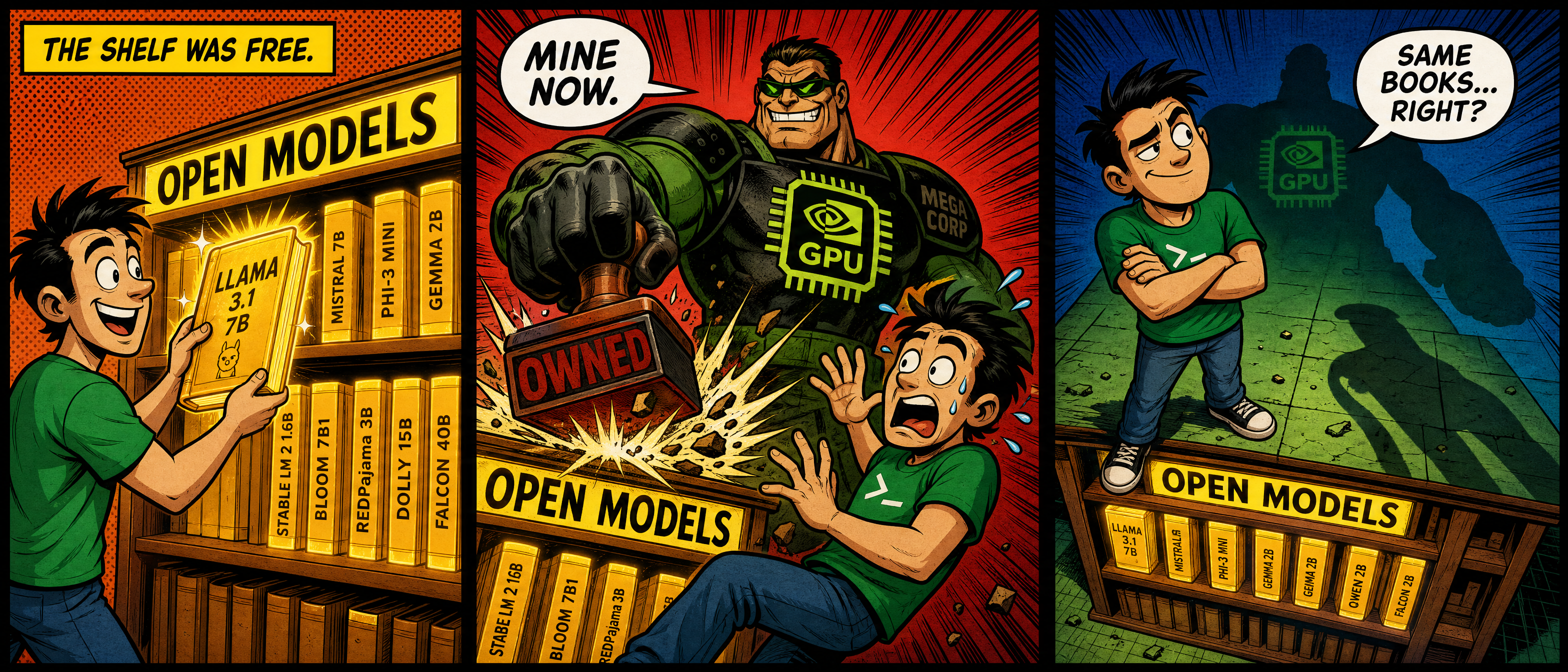
Thursday morning my whole feed was one story. Nvidia has agreed to buy Hugging Face for $12.9 billion. The Information broke it on the 26th, CNBC and everyone else had it within hours, and as I write this neither company has confirmed anything. TechCrunch notes there's no signed agreement yet and the whole thing could still fall over.
Assume it doesn't fall over.
My first reaction was a shrug. Open weights are open weights. A Llama checkpoint doesn't suddenly get a worse license because somebody else owns the download button now. Ten minutes later I was a lot less relaxed about it, and I've been going back and forth ever since....still haven't landed. That's basically what this post is.
The detail I keep coming back to
Per the FT reporting summarised here, Nvidia put another $500 million on the table at the end of 2025, at a $7 billion valuation. Hugging Face said no. Not over the money, but because they didn't want one dominant investor pushing their decisions around.
Nine months later they sold the whole company to that investor.
That's not a gotcha. Twelve point nine billion for everything is a completely different conversation than half a billion for a slice, and people are allowed to change their mind when the number moves that much. But it does tell you the independence thing was a preference and not a principle. Good to know which one you were dealing with.
What probably doesn't change at all
Most of the doom I read on Thursday was overcooked.
The licenses don't change. Apache-2.0 stays Apache-2.0. Weights already on your disk stay on your disk, and anything you mirrored, you keep. The Hub is a giant pile of git repos with LFS behind it and a nice front end, and you can't quietly close that down without everyone noticing the same afternoon.
Nvidia also has zero reason to wreck it. They sell shovels. A busy open model ecosystem is the best demand generator they've got, because every fine-tune somebody kicks off at 3am is compute that gets paid for eventually. The read that this is about defending chip dominance is obviously right. You don't drop thirteen billion on something and then break it.
So on "is open source AI dead now", no. Calm down.
What might change, quietly
The registry is not the models. That's the whole thing.
The registry is defaults. What comes up first when you search for an embedding model. Which quantisation formats get a proper badge and which ones you dig out of a forum thread. Which runtimes the Spaces actually support instead of technically support. What the download counts say, and download counts are how most people pick a model even if they'd never admit it.
None of that needs anyone to be evil about it. You just ship TensorRT support a bit sooner than ROCm support, every single time, and every one of those calls looks like sensible prioritisation on the day. Five years of that and the default path through the world's model registry runs through one vendor's stack.
The size of it is what makes this matter. The Hub is at roughly 2.9 million public model repos, a million datasets and 13 million users, and the usage is brutally lopsided, with about 1.5% of repos pulling 99.2% of all downloads. So "just fork it" is true and completely useless. You can mirror the weights. You can't mirror the gravity.
Where it gets actually interesting
The regulators.
Nvidia has spent the last couple of years getting bigger through deals that conveniently don't need a merger filing. Investments, licensing, compute commitments, hiring most of a team without buying the company. Those structures dodge review by design. Buying a company outright for $12.9 billion does not. This is the first move in a long while that has to walk through the front door.
And it shows up at that door with a record already behind it. The DOJ has been digging into Nvidia's position in high-end AI silicon since September 2024. The European Commission has been poking at the GPU market since 2023. China's SAMR opened its own probe in December 2024 over commitments made back in the Mellanox days, then dropped it once trade politics shifted.
What makes this one different is how obvious the stack is. Chips at the bottom. The software layer nearly everybody trains on in the middle. And now the shop window where the results get published and found. You'd struggle to draw a cleaner picture of vertical integration if you were trying to.
The question a competition authority asks is more or less the one I was already circling. Does neutral hosting stay neutral when the host sells the hardware, and what does that do to AMD, to Intel, to everyone building custom silicon.
Then comes the bit I find genuinely hard. Say a regulator agrees there's a problem. What do you actually make them do? Forcing a sale is way over the top. Splitting up a model registry barely makes sense as a sentence. So you end up with promises about behaviour, and promises about behaviour on a ranking surface are basically unenforceable. "Treat competing hardware fairly in search results and docs" is something you can put in an agreement and then never check again for ten years.
My guess is it goes through in nine to fifteen months with a pile of promises nobody can measure. Happy to be wrong about that, though I am not expecting to be.
The thing I'll actually watch
Not the ruling. Rulings are slow and the interesting part will be long over.
The signal is much smaller and anyone can watch it. See how fast non-Nvidia runtimes keep landing as first-class on the Hub. ROCm builds, Apple silicon, the custom accelerator crowd, whether their formats stay one click away or slide onto page two. That's measurable today and it answers the question years before any competition authority does.
And if you're building on this stuff, that's the number to keep an eye on, not the headline. The headline already happened.
If that gap widens over the next year, the shrug was wrong.