For about a year now, Google has been sending me a very specific kind of visitor. Search Console shows the same query near the top of my list almost every week: "where are claudes data centers". People search that, land on some post of mine that mentions Claude twice, and presumably leave disappointed, because until today this blog contained no answer.
This morning I finally sat down at my desk in Germany and did the digging properly. So here it is, the post I should have written a year ago. Where Claude actually runs, where the other big models live, and the nerdy numbers about buildings, chips, and frankly absurd amounts of power.
Fair warning: I had part of this wrong in my own head. More on that in a second.
Claude doesn't really have an address
First, the correction. For a long time I assumed Anthropic owned data centers the way Google owns data centers. It doesn't, or at least it didn't until very recently. Anthropic rents nearly all of its compute from two landlords, Amazon and Google, and Claude runs on three different chip families depending on the job: Amazon's Trainium chips for a lot of the training, Google's TPUs, and Nvidia GPUs.
So the pedantic answer to the search query is that Claude's data centers are mostly Amazon's and Google's data centers.
But one of them deserves the headline, because it was built for Claude specifically.
Indiana, mostly
The flagship is called Project Rainier, and it sits on former farmland in New Carlisle, Indiana, about 150 kilometers east of Chicago. Amazon opened it in October 2025 as an 11 billion dollar campus, the largest capital investment in Indiana's history, and Anthropic is the anchor tenant. This is where a large part of Claude gets trained.
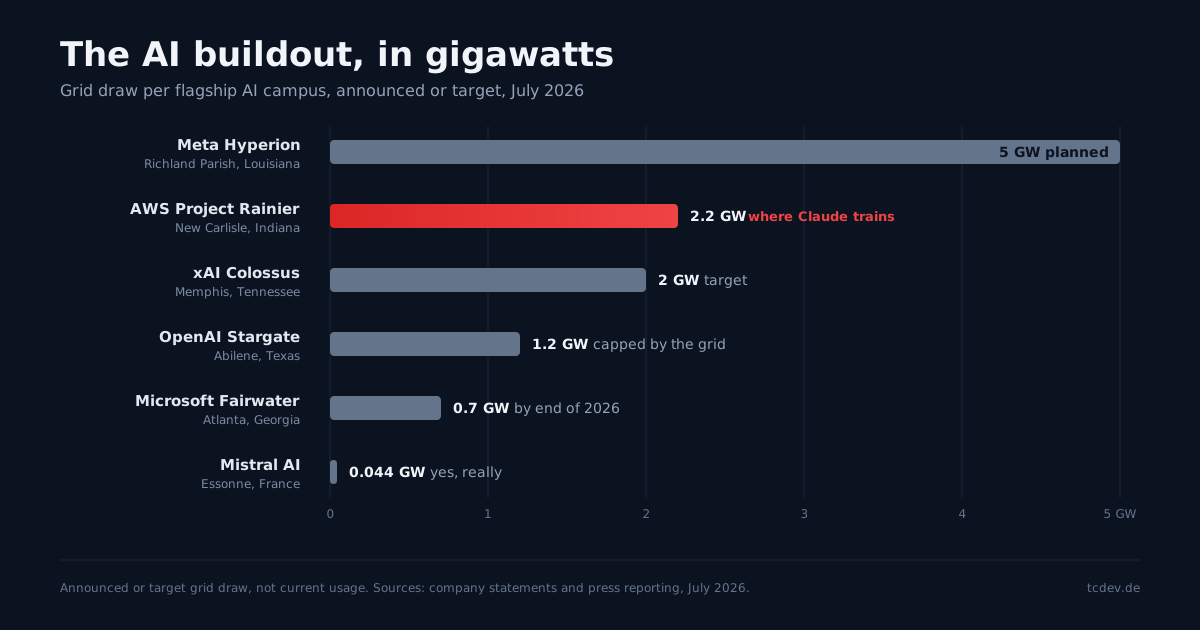
The numbers are the fun part. At opening the site held about half a million Trainium2 chips, with the count expected to double. The full buildout runs to roughly 30 buildings on around 900 acres, drawing more than 2.2 gigawatts from the grid, with 878 backup diesel generators standing by for bad days. That 2.2 gigawatts is enough for something like 1.6 million homes. For my German readers: Isar 2, the last big reactor we switched off, produced about 1.4 gigawatts. One AI campus in a cornfield now out-draws it comfortably.
Then there's the Google side. In October 2025 Anthropic signed a cloud deal giving it access to up to one million TPUs and more than a gigawatt of capacity coming online in 2026, reportedly worth tens of billions. Google doesn't say which of its regions host that capacity, which is normal and also mildly infuriating when you're trying to write this post.
And since November 2025 the ownership answer has started changing: Anthropic announced 50 billion dollars for its own custom data centers, built with Fluidstack, starting in Texas and New York, with sites coming online through 2026.
One more thing, because it trips people up. Training and inference live in different places. When you chat with Claude, your tokens might be served from an AWS or Google Cloud region far away from Indiana. The Indiana campus is the nursery, not the counter you're being served at.
OpenAI went shopping for a small country's worth of power
OpenAI's buildout has a name, Stargate, and a sticker price of 500 billion dollars. The flagship sits in Abilene, Texas, built by Crusoe for Oracle, and is designed to hold more than 450,000 Nvidia GB200 GPUs across eight buildings. It was supposed to keep growing past that, but in March the partners capped Abilene at 1.2 gigawatts because grid connection delays were running past a year. The chips exist. The transmission lines don't. That sentence describes most of the industry right now.
The rest of the map: OpenAI has named five more sites in Shackelford County and Milam County in Texas, Doña Ana County in New Mexico, Lordstown in Ohio, plus an unnamed Midwest location. Epoch AI keeps a running tracker of where each site actually stands, which I ended up reading for an hour.
And OpenAI still leans on Microsoft, whose new Fairwater campuses are my favorite nerd detail in this whole post. There's one in Mount Pleasant, Wisconsin and one near Atlanta, and Microsoft connected them with dedicated fiber into what it calls an AI superfactory, so data centers in two different states can train one model together. The Atlanta building runs straight off the Georgia Power grid with no UPS and no diesel generators at all. Someone did the math on what redundancy actually buys during a training run and had the nerve to act on it. Respect.
Memphis, where the permits went missing
xAI built its first Colossus cluster in a former Electrolux factory in Memphis, standing up 100,000 GPUs in 122 days, which remains one of the fastest infrastructure builds anyone has pulled off. By January the campus had grown to around 555,000 GPUs, roughly 18 billion dollars in hardware, expanding toward 2 gigawatts, smoothed by 168 Tesla Megapacks because GPU training load swings hard enough to upset a grid.
The speed is genuinely impressive and I won't pretend otherwise. But part of that speed came from running dozens of mobile gas turbines, at times without air permits, in an area that already had lousy air quality. Permits are boring machinery, and boring machinery is what protects whoever lives downwind, usually people who never got a vote on whether a frontier model moves in next door. Skipping that step and calling it velocity is a choice, and it tells you where the neighbors rank.
Meta is building something four times the size of Central Park
Last week, on July 13, Meta more than doubled the plan for Hyperion, its campus in Richland Parish, Louisiana: 5 gigawatts of compute and more than 50 billion dollars. The site covers over 3,200 acres, which is about four Central Parks, and gets its power from ten new gas-fired plants built by Entergy. There's a second cluster, Prometheus, coming online in New Albany, Ohio at around a gigawatt.
Five gigawatts is not a data center in any sense my brain grew up with. It's an industrial region with a login page.
And then there's Europe
Mistral's flagship site is in Bruyères-le-Châtel in the Essonne, about 30 kilometers south of Paris, run by a French operator called Eclairion. The location is delightfully on the nose: directly across from the CEA campus where France runs the supercomputers for its nuclear deterrent. In March, Mistral raised 830 million dollars to expand the site, a 44 megawatt facility packed with current-generation Nvidia hardware, delivered with help from Fluidstack, the same partner Anthropic picked for its US buildout. Small world.
Now hold the two numbers next to each other. Rainier: over 2,200 megawatts. Mistral's flagship: 44. That's a factor of fifty, and it is the entire European AI story compressed into one ratio. I honestly go back and forth on how much raw training scale matters versus efficiency and focus (ask me again next month), but fifty-to-one is not a gap you close with efficiency.
The efficiency argument does have one loud data point, to be fair. DeepSeek in Hangzhou claims its V3 model was trained on just 2,048 H800 GPUs for about 5.6 million dollars. Analysts think the real cluster was somewhat bigger, but even the skeptical estimates are a rounding error next to Abilene.
The bill for all of this
The IEA puts global data center electricity use at around 415 terawatt hours in 2024, doubling to roughly 945 by 2030, driven mostly by AI. That lands at just under 3 percent of global electricity, slightly more than Japan consumes today. In the US, data centers account for nearly half of all electricity demand growth between now and 2030.
Every company in this post is now, functionally, an energy company that also does software.
So, to the steady trickle of people who got here by searching where Claude's data centers are: Indiana, mostly. Plus unnamed Google regions, and soon Texas and New York. The thing I still can't find a straight answer to is which site actually serves my tokens when I ask Claude something from Germany at nine in the morning. Inference location is the number nobody publishes. If you happen to know, the contact page is new and it works.