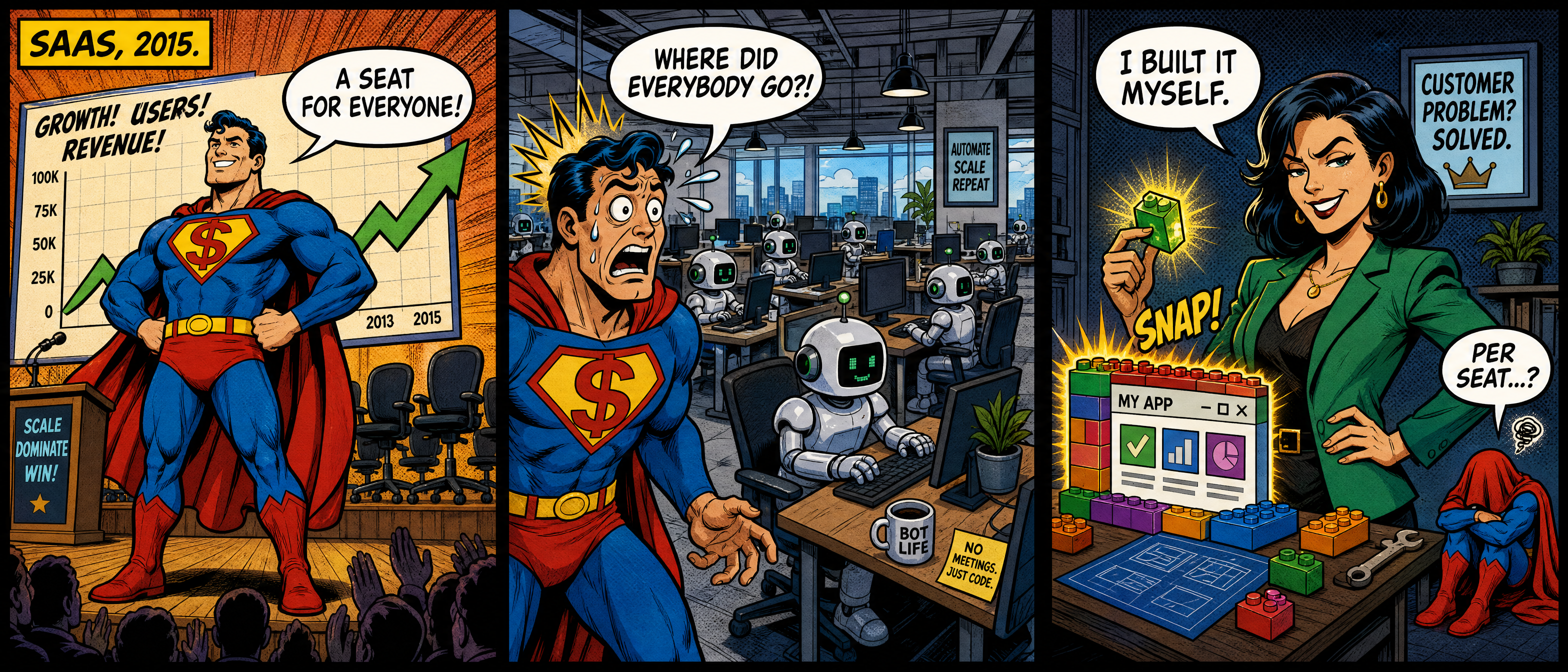
Last Tuesday I did the annual review of my own software spend, a spreadsheet ritual I do every summer at the kitchen table with too much coffee. Same exercise as every year, except this time one column made me laugh out loud: seats. Half the "users" I'm paying seat licenses for aren't people anymore. They're service accounts, API keys, and agents doing work while nobody is logged in.
I'm paying human prices for software that robots use.
That spreadsheet is the whole "SaaS is dead" debate in miniature. The software is fine. It runs, it does its job, nobody misses installing things from CDs. What's dying is the business model wrapped around it, and the wrapper is dying faster than most vendors want to admit.
The seat was always a proxy, and the proxy broke
Per-seat pricing was never a measurement of value. It was a convenient proxy: more employees using the thing, more value, more money. Fair enough in 2015.
Then agents showed up and the proxy snapped. An AI agent doesn't take a seat. It does the work of several seats and consumes none, which means the vendor's revenue model and the customer's value model now point in opposite directions. The market data says this is already happening: pure seat-based pricing dropped from 21 percent of SaaS companies to 15 percent in a single year, while hybrid models jumped from 27 to 41 percent. Bloomberg Intelligence expects subscriptions to fall from around 60 percent of software pricing toward 30 over the next decade, with outcome-based pricing growing from 10 toward 60. Gartner puts at least 40 percent of enterprise SaaS spend on usage, agent, or outcome models by 2030.
Confession time: I defended per-seat pricing for years. I worked at DeepL, a subscription company through and through, and I argued with a straight face that seats were the fairest model because they were predictable. I was wrong about the fairest part. Seats were predictable for the vendor. That was the point.
The market already voted
If you want to know where pricing is going, don't read analyst decks, watch what the biggest seat-seller on earth just spent money on.
Intercom renamed itself Fin, priced its support agent at 99 cents per resolved conversation, with nothing charged when the AI fails, and built a business on it. Salesforce launched Agentforce at two dollars per conversation, then had to follow with a flat two dollars per resolution, no charge if the customer escalates or walks away. And on June 15, Salesforce signed to acquire Fin outright for 3.6 billion dollars.
The company that built the per-seat empire just paid 3.6 billion for the company that proved you can charge per outcome instead. The argument is over. Everything after this is implementation detail.
One caution, because outcome pricing has a failure mode too. Klarna famously replaced the work of 700 support agents with AI, bragged about it, and then its CEO admitted they went too far and started hiring humans again because quality fell and customers hated it. Charging per outcome only works when the outcome actually holds. Resolved tickets that reopen next week are seats with extra steps.
Pricing is the visible symptom, not the disease
Fix pricing and you've fixed a third of it. The other two thirds are flexibility and go-to-market, and they're rotting from the same cause.
The classic SaaS product is a fixed opinion about how your business should work, sold at a fixed price, per human, per year. If the opinion doesn't fit, you buy another tool that holds a different opinion, and another, until you're a mid-sized company running dozens of subscriptions whose main integration layer is a person copy-pasting between tabs. Every one of those tools has a demo wall, an annual contract, a procurement dance, and a pricing page that says "Contact us" where the number should be.
That whole gestalt made sense when building software was expensive. It stopped making sense when building software got cheap, and it's getting cheaper by the quarter.
What I think replaces it
Not "no-code". I want to be precise here, because the no-code wave overpromised and mostly delivered brittle internal Frankenstein apps that one power user understands and everyone else fears touching.
What I mean is customizable business platforms. One platform, one data core, one permission model, and on top of it the company describes the workflows it actually needs and gets working software that fits, instead of buying fourteen fixed opinions and forcing its processes to match. AI made this plausible in a way it wasn't three years ago, because describing an app in plain language and getting something production-shaped back is now a realistic Tuesday, not a keynote demo.
Full disclosure, and discount everything I just said accordingly: I'm building one of these (Cordango), so I'm exactly the guy the incumbents would expect to write this post. Fine. But I started building it because of that spreadsheet, not the other way around.
The honest open question, the one I don't have a confident answer to, is whether incumbent SaaS can cross this bridge at all. Watching a vendor bolt "agentic pricing" onto a per-seat contract is like watching a newspaper add a website in 2005. The motion is right. The org chart underneath it isn't.
Renewal season hits this autumn. Count how many of your vendors quietly offer you a usage tier that didn't exist last year, and you'll know exactly how scared they are.