I am sitting on a balcony in Rhodes. There is a small jug of coffee in front of me that the kitchen porter, a guy named Stelios, just dropped off because he saw I was out here writing and figured I would want one. He did not check an app. He did not ask my room number. He just looked at me, made a small guess about a human, and acted on it.
That sounds like a tiny thing. It is not. It is the most disorienting moment I have had in months.
What four months in tech feels like
Let's recap quickly. In the last four months, I watched the company I worked for restructure around AI, and then I watched myself become part of that restructure. I wrote a whole post about what that meant. I also watched almost every product team I know quietly stop hiring juniors, start measuring tokens burned, and rebuild their roadmaps around "where does the agent fit." Twitter rebranded its idea of an engineer about three separate times.
If you work in tech right now, you know the feeling. Every Monday morning has the energy of a tiny earthquake. You open your laptop and somebody has released a new model, a new framework, a new flavor of agent, a new opinion about what your job is supposed to look like.
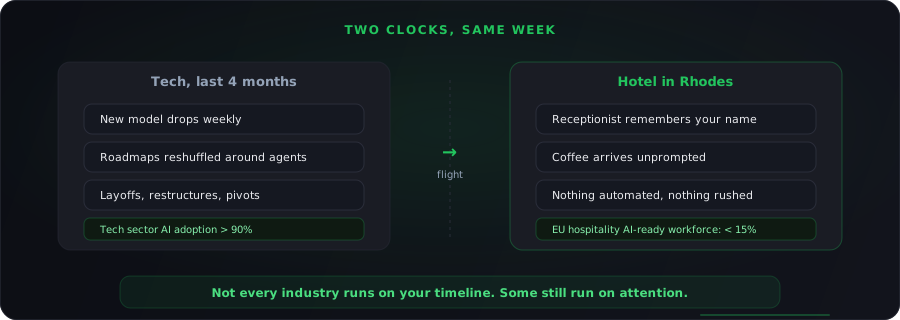
The McKinsey State of AI 2025 report says 88 percent of companies now use AI regularly in at least one function, with the technology sector already past 90 percent and pulling further ahead. That number sounds clinical until you remember the cost. Behind every percentage point there is a roadmap that got torn up, a team that got reshaped, and a few people who stopped being the answer to a question their manager used to ask them.
I have spent four months metabolizing that. Updating my own mental model. Trying not to spiral about it. Trying to figure out what I am now, professionally, in a world where the floor keeps moving.
And then we packed two suitcases and flew to Rhodes.
The hotel has not heard about any of this
Here is what I expected to happen on vacation in 2026. I expected QR menus everywhere. I expected an AI concierge in the lobby app. I expected the front desk to be half-staffed and to point me at a tablet. I expected the buffet to have one of those creepy little robots trundling around delivering plates.
None of that happened.
The receptionist, an older woman whose English is sharper than mine on a tired day, took my passport, made a tiny joke about the spelling of my name, and asked if my wife wanted a kettle in the room because it gets cool at night. The waiter at dinner remembered we sat near the window the night before. The cleaning staff knock at a polite distance and never the same hour twice, because they read the room and noticed we sleep in.
This entire operation runs on people who pay attention to other people. There is no AI seam anywhere. The systems behind the scenes might be modern. The booking engine, the property management software, fine. But the surface, the part I actually experience as a guest, is a hundred-percent human craft.
And the data backs up why. According to industry reporting, fewer than 15 percent of hospitality employees in the EU have the digital skills considered essential for AI-enabled systems, compared with over 40 percent in IT and finance. The gap is not closing fast. Hospitality is structurally late to this wave, and honestly, walking around this hotel, I am not sure that is a problem.
It might be the feature.
I had been wrong about something
For about a year I have quietly assumed that any industry not racing toward AI was simply behind. Underinvested. Stuck. A bit slow. I would not have said it out loud at a conference, but I felt it. If you were not measuring agent adoption, you were going to lose.
Sitting here, I think that take was lazy.
There are entire categories of work where the product is the human contact. The whole reason you booked a hotel instead of an Airbnb is that you wanted to be looked after by a person who recognises you on day three. The whole reason you sit at a real restaurant and not a vending machine is that someone reads your mood and pours you the right wine. AI can probably mimic some of this. I do not think it can replace it, because the value is not the action. The value is that a human chose to do it for you.
There is a quiet moat there. Not a tech moat. A trust moat. A "this is what we do here, and a machine cannot fake it" moat.
The strange relief of an old industry
What I did not expect was how much this would relax me.
For four months my nervous system has been running a background process called is your job still there next quarter. It is exhausting. It chews up sleep, attention, conversation, and a lot of the joy of working on something. The first day in Rhodes I noticed I was scanning the lobby for the AI thing. Looking for the catch. Waiting for the part where some agent intercepts me.
It never came.
By day three I had downshifted in a way I did not know was possible anymore. I was talking to Stelios about his football team. I was reading a paper book. My brain stopped reflexively rehearsing the next pivot. It was the first time in months I did not feel like I needed to ship something to justify existing.
Four months of AI chaos can convince you that the entire world is being rebuilt at the same speed as your timeline. A week in a hotel that has not changed in thirty years is a useful counterweight.
I do not think this means tech is wrong about its pace. The pace is real, the disruption is real, and the layoffs I lived through are not going to be the last ones. The market is doing what the market is doing.
What I do think is that it is healthy, especially now, to spend a week somewhere that operates on a slower clock. Somewhere people still introduce themselves. Somewhere a human guesses correctly about what you want. Somewhere the entire system runs on attention rather than throughput.
What I am taking home
I will be honest, I do not have a tidy moral here. I am not going to claim hospitality has unlocked the secret of post-AI work. Big chains are absolutely deploying agents behind the scenes, and the BCG report on AI-first hotels makes it pretty clear this surface will eventually change too. Maybe in five years even the receptionist in Rhodes will be staring at an AI suggestion screen while she talks to me. Maybe Stelios will be replaced by a delivery cart. I hope not. I suspect parts of it will happen anyway.
But for this week, the contrast is doing something to my head that no amount of journalling and podcast listening managed at home. It is reminding me that not every system runs at the speed of my LinkedIn feed. That craft and presence still hold a kind of value the market has not figured out how to discount. That when the next quarter of my career arrives, I do not have to meet it from the same anxious posture I have been carrying around since February.
The kettle is whistling. I should probably go inside.