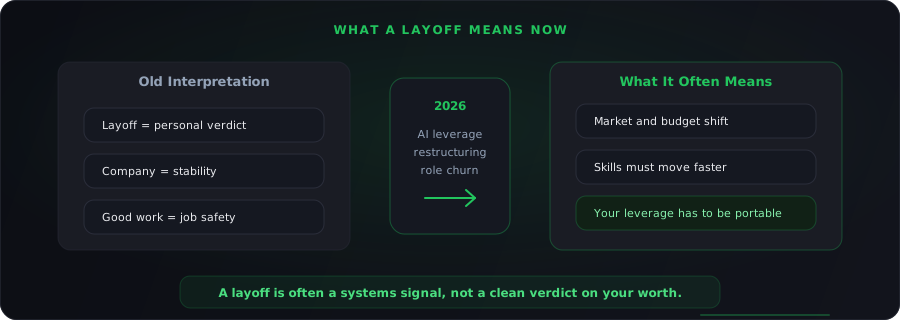
Getting laid off from DeepL was not on my 2026 bingo card. It is a strange sentence to write because even now, part of me wants to soften it. Dress it up. Call it a transition or a strategic realignment, whatever phrase HR departments are using this quarter to make a sharp thing sound rounded. But no. I got laid off. And the longer I sat with that sentence, the more I realized the interesting part was not just the event itself. It was what that event means now, in a world where layoffs have become weirdly common, AI is changing the shape of work in real time, and entire industries are pretending this is all more orderly than it really is.
A layoff used to feel like a verdict
For a long time, getting laid off carried this silent accusation. People would say all the right comforting things, of course. It's not personal. These things happen. I'm sure you'll land somewhere quickly. But underneath it there was often this old suspicion that if you were really indispensable, really top-tier, really impossible to replace, you would still be there. I do not think that story survives contact with the current market.
Look at the scale of what has become normal. Layoffs.fyi is tracking 101,550 tech employees laid off across 120 tech companies already. That is not a story about a few underperformers getting filtered out. That is a structural story. A market story. A capital story. A leadership story.
And the broader labor picture is even messier. The World Economic Forum's Future of Jobs Report 2025 says structural labor-market transformation through 2030 will reshape 22% of today's jobs, with 170 million new jobs created and 92 million displaced. On average, 39% of workers' existing skill sets are expected to be transformed or outdated by 2030.
That is not a small correction. That is the ground moving. So no, I do not read a layoff today as a clean judgment on someone's worth. That interpretation belongs to a more stable era than the one we're living in.
What it actually means in 2026
Being laid off today usually means you were standing at the intersection of forces that have very little interest in being fair. It can mean the company hit a budget number. It can mean leadership changed its thesis.
It can mean AI made part of the workflow faster, and management confused faster with smaller.
It can mean your team was excellent and still got caught in a wider optimization pass because somebody upstairs needed to tell a cleaner story to the board.
It can even mean you did your job well in a system that no longer knows how to value that exact kind of work.
That last one is the part I think many people still underestimate. The labor market is not just rewarding quality anymore. It is rewarding leverage, visibility, adaptability, distribution, and the ability to sit next to AI instead of directly in front of it. That is a different equation from the one many of us built our careers around.
The old career contract is broken
This is the part that hit me hardest, honestly.
For years there was an implied deal in tech. Be good. Work hard. Build real things. Help the team. Stay useful. In return, you would probably keep moving forward. Not perfectly, not smoothly, but roughly in a straight line.
That contract feels badly outdated now.
According to the same WEF report, 59 out of every 100 workers will need training by 2030, while 40% of employers expect to reduce staff where AI can automate tasks. At the same time, 85% say they plan to prioritize upskilling. That contradiction tells you almost everything. Companies want the gains from transformation, but many are still figuring out whether they want to carry the people through that transformation or just reshuffle the spreadsheet and call it strategy.
So a layoff in today's world often means the company changed faster than the psychological contract did. Employees were still operating on loyalty, competence, and consistency. The market moved to optionality, efficiency, and ruthless reallocation.
The emotional part is still real
None of this makes it painless.
I can intellectualize this all day long and still tell you it stings. Your brain may understand the macro story while your nervous system is busy hearing something much smaller and much meaner: you were not needed enough. That feeling is real even when it is wrong.
And there is also the identity problem. When you work somewhere good, especially somewhere you are proud to be, the company name starts attaching itself to your sense of self. You do not just say what you do. You say where. It becomes part of your introduction, part of your momentum, part of how other people read your trajectory. When that disappears overnight, you are not only losing a role. You are losing a frame.
That is why layoffs feel so disorienting now. Not because people are weak. Because modern work asked us to build identity on top of systems that are increasingly transactional underneath.
What I think a layoff means now, if you are paying attention
I think being laid off in 2026 means you need to stop confusing institutional stability with personal security.
It means your employer can still matter a lot while being a terrible place to store your whole sense of worth.
It means your title is not portable enough.
It means your real assets are the things you can carry out with you: judgment, taste, relationships, credibility, proof of work, the ability to build, the ability to learn fast, the ability to create momentum without waiting for permission.
This is one reason I keep caring so much about writing, shipping, building in public, and owning an actual point of view. Those things are not vanity projects anymore. They are part of career resilience. They are evidence that you exist outside the org chart.
That may sound dramatic, but I do not think it is. In a market this fluid, the people who can reassemble themselves fastest have a real advantage.
In today's world, a layoff does not automatically mean you failed. It often means the system changed shape faster than your role did.
So where does that leave me?
Probably where it leaves a lot of people right now. A little bruised. A little clearer. Less naive than before.
I am not interested in pretending getting laid off is secretly amazing. Sometimes the internet tries to do that too. Best thing that ever happened to me. Maybe for some people, eventually. But right after it happens, it is mostly disruptive, humbling, and expensive.
What I do think is this: if you can get past the first hit to the ego, layoffs can force a more honest look at where your leverage really lives. Not where your LinkedIn headline says it lives. Not where your employer brand says it lives. Where it actually lives.
For me, that means building. Writing. Having a sharper point of view. Owning my own direction more deliberately than before.
And maybe that is what being laid off means now more than anything else. Not that you are done. Not that you were not good enough. Just that the old map is less useful than people want to admit, and you are now being pushed, whether you asked for it or not, to navigate by something more personal and more durable.