Sam Neill died on Monday. He was 78, in Sydney, and it was sudden, which has its own particular cruelty to it given he had spent three years beating a lymphoma that was supposed to be the thing that got him. He'd been cancer free since April.
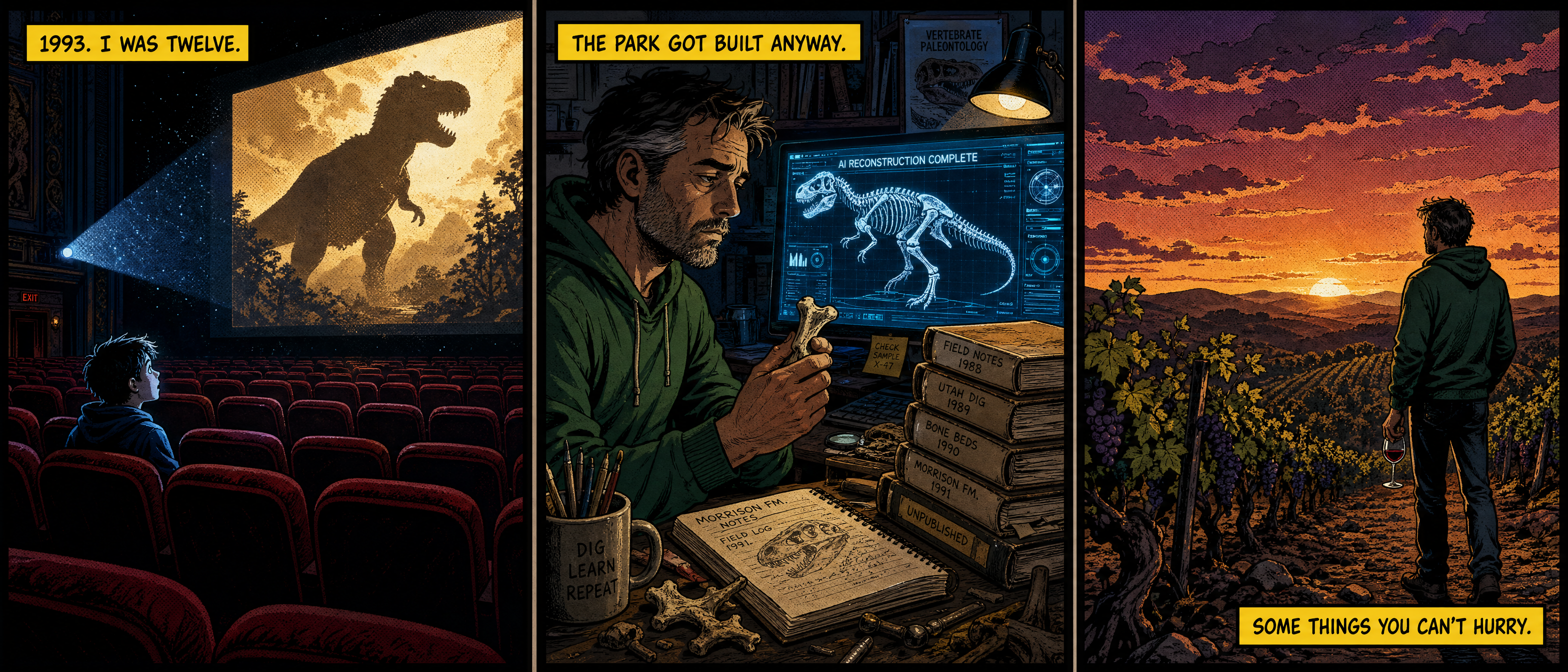
I was twelve years old in September 1993, and Jurassic Park was the first film I ever saw in a cinema.
What I remember is the glass of water. Everyone remembers the glass of water. That little trembling ring on the surface, the boom you feel through the seat instead of hearing, the whole room going quiet in the same second. I had no framework for any of it. I'd watched films on television my whole life. I had never been inside one before.
And the man in it, the one with the hat and the dirt under his fingernails and the permanent air of being mildly annoyed by children, was Sam Neill. He was 45 years old.
I'm 45 now.
That's the sentence I've been sitting with since yesterday, and it's why you're getting this post instead of the one I meant to write.
The horror I missed when I was twelve
Alan Grant is a paleontologist, and the film is unusually clear about what that actually means. He's a man who has handed his entire adult life over to patience. Brushes and dental picks. Seasons in the Montana badlands to pull half a skeleton out of the dirt. He can hold a fragment of bone and tell you how the animal moved, how it hunted, whether it was fast. That knowledge cost him thirty years and it isn't transferable. You can't download it.
Then Hammond flies him to an island and shows him a living Brachiosaurus.
At twelve, that was the good bit. The awe, the music coming up underneath, the sunglasses falling out of his hand. Watching it now I see something else sitting in that scene, and I don't think Spielberg buried it especially deep. I just wasn't old enough to have anything to measure it against.
Grant isn't only amazed there. He's obsolete. In a single afternoon a company skipped every part of what he does. They skipped the digging and the guessing and the arguing at conferences and the thirty years. They never bothered to read the fragments. They just made the animal. Every question he spent a career carefully approximating an answer to is now something you could settle by walking outside with a clipboard and looking.
The raptors in the kitchen are the scary part of Jurassic Park. The Brachiosaurus is the sad part.
Twenty years, nine seconds
I've spent about two decades getting good at a thing. Not world class. Good. The kind of good where you look at a problem and something at the back of your skull just knows, and you couldn't fully explain how if someone asked, because the explanation is twenty years long.
Then a model does it in nine seconds.
I want to be careful here, because I've been loud and mostly cheerful about building with AI, and I'm not going to suddenly discover principles now that it's my ox getting looked at funny. I use these tools daily. I've shipped things this year I could not have shipped alone and I'm not sorry about a single one of them. (I would also like to keep eating, so.)
But there's a feeling in this industry that nobody wants to say out loud, and "fear of being replaced" is too clean a phrase for it. Too dramatic. Too tidy. What it actually feels like is what's on Grant's face out in that field. You're standing there holding your life's expertise, looking at a living thing, working out that the expertise was the long way round.
The park gets built anyway
Here's the line everyone is quoting this week. It's Grant's, and it's the last line of the film.
"Mr. Hammond, after careful consideration, I've decided not to endorse your park."
And Hammond, beaten, says: "So have I."
Great ending. It's also a lie, and everyone sitting in that cinema in 1993 already knew it, because there was going to be a sequel. And there was. Then another. Then a whole second trilogy, and Neill himself came back twice, at 54 and at 74, to walk around a park he had formally declined to endorse.
That's the part that gets me at 45. Grant wasn't wrong. He was right about every bit of it, and being right did not matter even slightly, because his endorsement was never actually required. Hammond was being polite. The park was always going to open.
I think about that every time somebody senior and thoughtful writes a careful piece about what we ought to be doing with AI, and it gets four hundred likes, and then nothing happens at all. Our endorsement is decorative. The park is open, the tickets are sold, and we all have badges.
The weird part
I had to put my phone down for a bit yesterday, because of a thought I couldn't shake off.
Jurassic Park is a film about using technology to bring back the dead. It was made by people who were reasonably confident that this was a cautionary tale. Sam Neill died on Monday, and he is precisely the sort of asset that gets brought back now. There is a rights conversation happening somewhere this week. Eventually there'll be a version of him, and it will be good enough, and it will be announced as a tribute, and people will cry at it.
Life finds a way. So does licensing.
The clock you can suddenly hear
When you're twelve, the adults in a film don't have ages. They're just Adults, a fixed category, like weather. It does not occur to you that the man on the screen is carrying a specific number of years, that one day you'll be carrying the same number, and that his will run out first.
Sam Neill was 45 when he played Alan Grant. I'm 45. The kid in the seat turned into the man on the screen, and the arithmetic did what arithmetic does, quietly, without asking anyone.
The actors of your childhood start dying, and that's the clock. You can hear it now. It was always running, it was just doing it in another room.
In tech we get issued a second clock, faster and stupider than the first. Forty-five around here is already a soft punchline. Now add a technology whose entire pitch is that accumulated experience can be compressed and skipped, and you end up ageing in two directions at once. The body clock says there's less ahead of you than there was. The industry clock says the part you already spent is worth less than it was. Holding both of those in the same week is a strange way to live.
Two Paddocks
Here's the fact I can't get out of my head, and it's the reason this ended up sad instead of sour.
In 1993, the same year he played the man whose life's work got leapfrogged by an instant miracle, Sam Neill bought five acres in Central Otago and planted Pinot Noir.
He called it Two Paddocks. Pinot is about the least accelerable substance on earth. You put it in the ground and for years it gives you nothing. Then it gives you something bad. Then, if the site is right and the season cooperates and you didn't cheat anywhere, it eventually gives you something worth opening. He grew it in a country that was internationally famous for Sauvignon Blanc, which is a polite way of saying he picked the slow, unfashionable, expensive option and then stayed with it for thirty-three years. Four small vineyards across three valleys. Certified organic from 2017, which is another way of saying he decided to make it harder.
None of this was for a press release. It's a tiny operation. He did it because it took a long time and he liked that it took a long time.
He was funny about the dying, too. He told the ABC he wasn't frightened of it in the slightest, just that it would be "very irritating". But then the Guardian asked him the same thing in 2023, in the middle of chemotherapy, and he said this:
"I'm not afraid to die, but it would annoy me. Because I'd really like another decade or two, you know? We've built all these lovely terraces, we've got these olive trees and cypresses, and I want to be around to see it all mature. And I've got my lovely little grandchildren. I want to see them get big."
Read that again, because I've now read it about nine times.
The man was in Jurassic Park. He was in The Piano and Peaky Blinders and a hundred other things. And when he was staring down a cancer with a bad survival rate, and somebody asked him what he wanted more time for, he said: the trees haven't matured yet. The grandchildren aren't big yet.
Not one word about another film. The two things he wanted more time for were the two things on the list that physically cannot be hurried.
Then he beat it. Remission, cancer free, told everyone in April. And then he died anyway, suddenly, on a Monday in July, with the terraces built and the olive trees still coming along and the grandchildren not big yet.
I don't have a lesson
That isn't me being coy. I turned this over for a full day looking for one and it isn't there.
I spend my working life trying to make things faster. That's the job, and it's most of what I write about here. And I've spent this week reading about a man who played a fossil hunter made redundant by a shortcut, who in that same year planted a crop that cannot be shortcut, and whose only real complaint about dying was that the slow things weren't going to be finished in time.
The vines he put in the ground in 1993 are thirty-three years old. They're still out there. They'll make wine this year without him and it will be perfectly fine, because that's how vines work. That's the entire trick of them.
I'm going to find a bottle of his Pinot this weekend. Not really as a tribute. I just want to drink something that took thirty years and could not be hurried, in a week where everything else I touch is trying very hard to prove that it can.