The last post on this blog with an em dash in it went up on April 18. It was a fairly dry piece about isolating DeepL glossaries between tenants and it had eighteen of them. Since then I've published 32 posts without a single one.
That's on purpose. Around the same time I complained in a post about building an app with Claude that "the em dash addiction is real", and the instructions file for the Rasepi blog (the one the AI tools have to read before they're allowed to touch anything) has this line in it, first sentence in bold:
Never use em dashes (—). This is the single most obvious AI tell.
I wrote that, and I knew better when I did. I'd like to take most of it back.
So where does the thing actually come from?
The em dash is called that because it's roughly as wide as a capital M, and writers have used it for centuries for one job: showing a break. A thought that gets interrupted, an aside that cuts into the middle of a sentence, or someone who just stops talking because they can't finish.
My favourite example is in the Bible. Exodus 32, right after the golden calf, Moses goes back up the mountain to ask God to forgive the people, and in the King James Version it reads:
Yet now, if thou wilt forgive their sin—; and if not, blot me, I pray thee, out of thy book which thou hast written.
He never finishes the first half of that sentence. The Hebrew breaks off right there too, commentators call it aposiopesis, which is a fancy word for stopping mid-sentence, and I'd guess he stops because what he's asking for is too big to say out loud. The dash is the one mark that can show that.
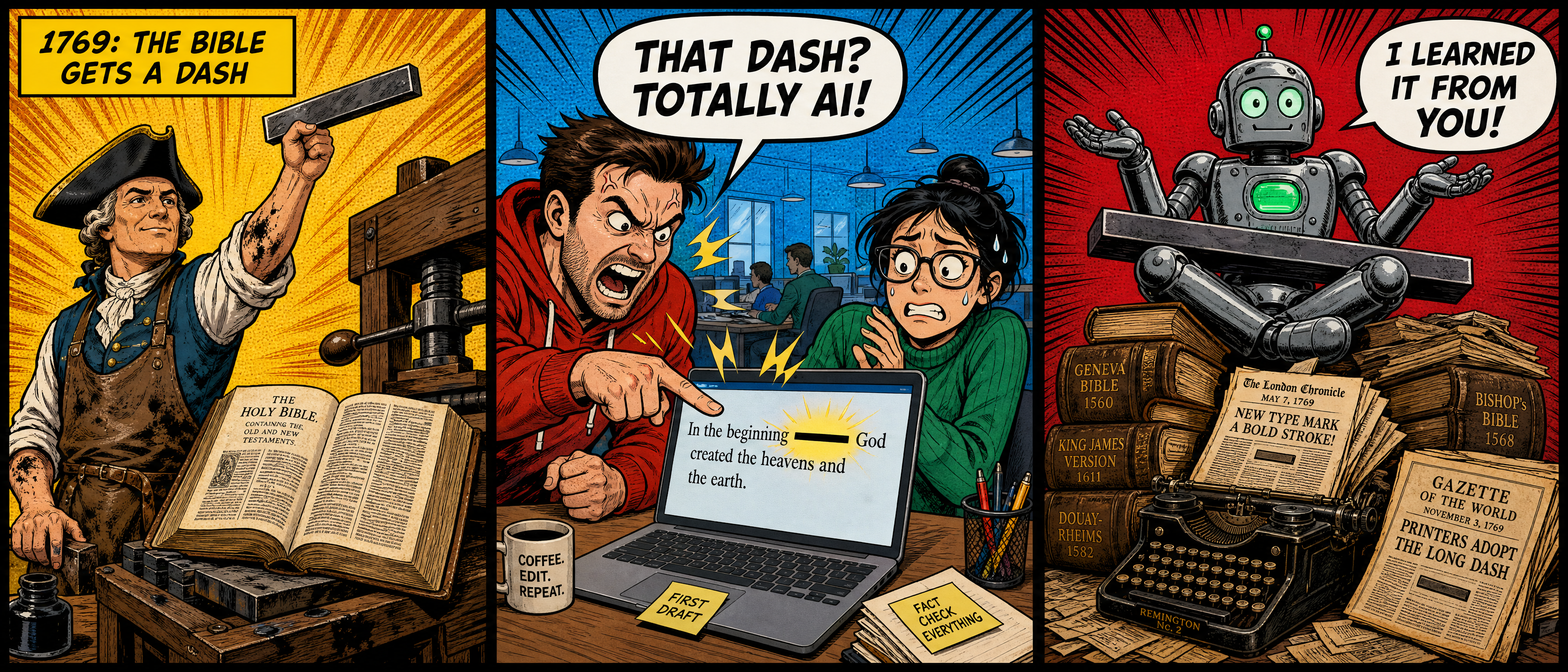
(I'd assumed this dash went all the way back to the 1611 original. It doesn't. The scan of the University of Pennsylvania first edition only has a semicolon there, and by the time of the 1769 Oxford edition somebody had set a proper long dash, which is the text most King James Bibles still print today.)
It's also, as far as I can tell, the only dash in the entire King James Bible. I had my AI grep the Project Gutenberg text for it (yes, I see the irony) and it found one, in close to 800,000 words, doing the one job it's there for. Hardly a machine-gun approach to punctuation.
If you want the other extreme, Laurence Sterne started publishing Tristram Shandy in 1759 and got called "that dashite Sterne". His dashes come in different lengths and are often treated as though they were words. I had it count the Gutenberg edition too, out of curiosity, and it came back with roughly 9,000 of them in about 180,000 words, so around 50 per thousand words. A hundred years later Emily Dickinson punctuated most of her poems with dashes instead of commas and full stops, and in her manuscripts they slant up or down and come long or short. Scholars have been squinting at those for decades.
None of these people had a GPU.
Why the models love it so much, and why that's on us
The best explanation I've read comes from Sean Goedecke, who wrote a whole post on exactly this question last October. His argument goes roughly like this: between 2022 and 2024 the big labs started feeding their models huge piles of digitised print books, because books are about the best-quality text you can get, and a lot of what's out there is old, late 1800s and early 1900s. That happens to be when dash usage in English was at its highest, with one study putting the peak around 1860, and Moby-Dick alone has 1,728 of them. So the model writes a bit like a Victorian novelist, because we handed it a library full of Victorian novelists.
To be fair, Goedecke himself says the theory is "still largely based on speculation" and nobody outside the labs really knows. There's a paper from March this year that blames markdown-heavy training data and post-training instead, and it has the number I find the most honest in this whole debate. Published human essays come in at about 3.2 em dashes per thousand words and GPT-4.1 at about 10.6. So yes, the models overdo it by roughly three times, and I'm not going to pretend otherwise.
But overdoing something we taught it is a long way from inventing it. Whichever theory wins, every dash in that training data was put there by a person, and Sterne at 50 per thousand would get flagged by every AI detector on the planet.
Monospace is getting the same treatment now, which is somehow even dumber
The design version of this panic is monospace fonts, the typewriter look where every character has the same width, which apparently now means a website was vibe coded.
The funny part is how it got there. In November 2025 Anthropic published a guide on getting Claude out of the generic "AI slop" look, purple gradients on white and Inter everywhere, and one of the fonts it suggested instead was JetBrains Mono. Now "all-caps monospace labels" sit on lists of AI design tells. The fix turned into the next tell.
Monospace exists because typewriters moved the carriage the same distance for every key, so every letter had to be the same width. Howard Kettler designed Courier for IBM in 1955, and Hollywood still wants screenplays in 12-point Courier because one page comes out at roughly a minute of screen time (a look at 2,520 scripts earlier this year says it's closer to 55 seconds, but fine).
And the typewriter had no dash key either, which is why people typed two hyphens for one since at least the 1890s. Word's AutoFormat turns that double hyphen into an em dash by default, macOS does the same and so does the iPhone. A lot of the em dashes people point at were put there by the software rather than by the person typing. The Chicago Manual of Style still tells you how to set them, no space on either side.
I've spent most of my working life staring at monospace in an editor and a terminal, like every other developer, and if fixed-width type means a robot wrote it then every terminal since the seventies was secretly an LLM.
The tell already moved, and nobody told the people still counting dashes
The panic really kicked off in spring 2025. The Washington Post ran a piece in April about people calling it the "ChatGPT hyphen", Rolling Stone asked two days later whether em dashes are really a sign of AI writing, and McSweeney's ran The Em Dash Responds to the AI Allegations, which ended up as their most-read piece of the year. "I'm in Austen. I'm in Baldwin." Fair point, honestly.
Then on November 13, 2025, Sam Altman posted this:
Small-but-happy win: If you tell ChatGPT not to use em-dashes in your custom instructions, it finally does what it's supposed to do!
That was the end of the em dash as a detector, for anyone paying attention. It's one line in the settings now, and I know that because I've written that line myself, more than once, in more than one file.
So think about who actually gets caught today. The person pasting three paragraphs of nothing out of ChatGPT has custom instructions that strip the dashes, or a tool that does it for them. The person who still has em dashes in their text is the one who reads a lot of books, writes in Word or types on a Mac. That's who gets flagged.
If you're the one in the team chat going "lol, ChatGPT wrote this" every time you see a long dash....you're mostly going to accuse the colleagues who actually read, and you'll wave straight through the stuff you were trying to catch.
What gives AI text away is the content, and it always was. Sentences that sound like they're saying something and aren't, three tidy bullet points for every thought, the same "it's not X, it's Y" rhythm in every paragraph, an ending that wraps everything up with a bow. You can't grep for any of that. You have to actually read the thing, and I suspect that's the real reason people would rather count dashes.
So am I lifting the ban?
Honestly, not yet, and I'm a bit annoyed at myself about that. The rule is still in the file, partly because a reader who's been trained to see a dash and think "robot" will think it no matter how many Victorian novels I quote at them, and partly because I've gotten used to writing around it. It does force you to join your sentences up properly, which isn't the worst habit to pick up.
But I know that makes me part of the exact problem I just spent this whole post on. Moses got one, Sterne got nine thousand. Maybe the next post here gets one too, somewhere in the middle, where a sentence actually breaks off.