On June 26th OpenAI previewed a new model called GPT-5.6, and the flagship variant is named Sol. I read the announcement on my phone in the queue for coffee, half expecting the usual benchmark parade. The benchmarks are there, and they're strong. One sentence stopped me anyway, and it had nothing to do with coding scores.
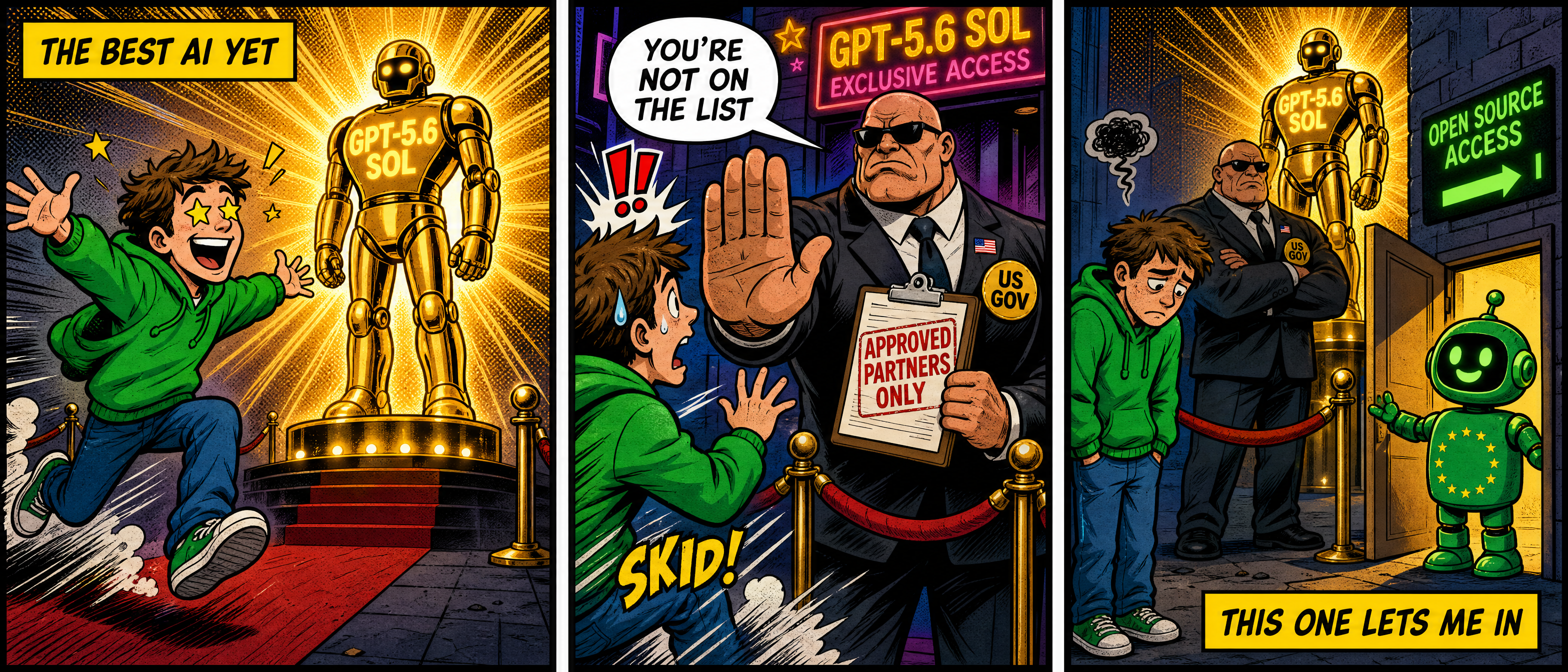
OpenAI is starting the rollout with a limited preview for "a small group of trusted partners whose participation has been shared with the government."
Read that again. It doesn't say shared with the public. It says the government.
First, give Sol its due
I don't want to pretend this is a mediocre model hiding behind a security story. It isn't.
The GPT-5.6 series comes in three tiers. Sol is the flagship, tuned for coding, biology, and cybersecurity, with a "max reasoning effort" mode for the hard problems. Terra sits in the middle, roughly GPT-5.5 performance at half the price. Luna is the cheap, fast one. Sol reportedly scored 91.9 percent on Terminal-Bench 2.1, which is the kind of number that makes me want to point Codex at it immediately, and the pricing (5 dollars per million input tokens for Sol, down to 1 dollar for Luna) actually undercuts the competition.
So if this had shipped the normal way, I'd already be running it. That's the part that makes the rest of it land harder. This is a genuinely good product, and you still can't have it.
The part that isn't normal
Here's the gate, laid out plainly. Access to Sol went to roughly 20 partners whose names were individually approved by the US government, at the government's request. This follows a Trump administration executive order that asks AI labs to voluntarily give the government up to 30 days of pre-release access to any model with advanced cyber capabilities, the stated fear being those capabilities landing in the hands of hostile nation-states.
There's no public enrollment. ChatGPT isn't even in the preview. You get in through an OpenAI account representative, and only if your name is on a list that Washington already signed off on.
I went and checked, half out of curiosity, whether someone like me could get near it. The answer is no, and not the "no, pay us more" kind of no. It's the "you are not the sort of entity whose name goes on that list" kind. (I build with these models every single day, so this is not an abstract complaint for me.)
This is not the Cloud Act. It's the thing sitting underneath it.
I have to correct myself a little here, because I wrote something recently that this news complicates.
A couple of weeks ago I argued that the Cloud Act is mostly an excuse we in Europe hide behind to avoid fixing our own broken market. I still believe that when it comes to why nobody switches off Slack. But I was too quick to sweep the entire sovereignty worry into that one bin, and this is the piece I underrated.
The Cloud Act is about data access. It governs whether a US authority can reach data that sits on a US company's servers. Real problem, but it is a problem about your data. What OpenAI just did is about the capability itself. The question is no longer whether Washington can read what you feed the model. It's whether Washington will let you use the model at all.
Those are not the same fear wearing different coats. One is a subpoena. The other is a guest list.
And if your company's real advantage runs on Sol, you are not a customer in any way that used to mean something. You are a name on a list kept in a building you have no vote in. Lists get shorter exactly as easily as they get longer.
Even OpenAI seems uneasy about it
Credit where it's due, OpenAI did not dress this up as a feature. They said they don't believe this kind of government access process should become the long-term default, and that gating the model this way keeps the best tools away from the developers, enterprises, and cyber defenders who need them. When the company that profits from the product is the one filing the objection, that's worth noticing.
The quieter detail is the one that actually bothers me. OpenAI is reportedly building a "repeatable vetting process" with the administration for future releases. Repeatable. You build the machinery for a government-approved access list once, it works, and then it stops being an emergency measure and becomes the on-ramp. The preview itself isn't the frightening thing. The scaffolding going up around it is.
Suddenly the European bet looks a lot less quaint
A few days ago I wrote about Europe finally funding a frontier model, and I spent most of that post grumbling that the money behind it is a rounding error next to what OpenAI burns in a quarter. Still true. But this week reframes why you'd want the European thing in the first place.
The argument for an open-weight sovereign model always had a slightly theoretical edge to it. "What if you get cut off." This week "what if you get cut off" grew a concrete shape: an approved-partner list, about 20 names long, and yours is not one of them. An open-weight model you can download and run on European hardware has exactly one property that Sol does not. Nobody has to approve you. It can trail on benchmarks and still win the only contest that matters on the day the list gets edited, which is whether you are permitted to run it.
I made a version of this point about hosting and free tiers already. It holds here too. A slightly worse tool that nobody can revoke beats a slightly better one that somebody else can switch off.
Where that leaves me
I'm not going to stop using the American models. They're the best tools I have, Sol included the moment it's actually reachable, and saying otherwise would be posturing. I ship on Cloudflare too, feel a little guilty about it, and keep right on doing it.
Something shifted this week though. The frontier used to behave like a market. You paid, you got the best model, and everybody was welcome as long as the invoice cleared. Now the best American model comes with a bouncer, and the bouncer answers to the government.
The question I can't put down isn't whether Europe can build something as good. It's what happens the first time that list gets shorter, and whose name is the one that comes off it.