On Thursday night I pointed my coding agent at Kimi K3 and handed it the exact task I'd given Fable 5 the day before. Same repo, same messy refactor, same prompt I'd already watched one model chew through.
It did it. Cleanly, in one pass, and my bill for the run was a rounding error next to what the day before had cost.
I sat there for a second longer than I'd like to admit. Not because a model wrote some code, that happens all day now. Because this one is open weights, made by a Chinese lab, and in a couple of weeks anyone will be able to download the whole thing and run it without asking me, or OpenAI, or the US government, for anything.
What actually happened, precisely
Kimi K3 did not flatly beat Fable 5 at everything. Moonshot's own writeup says so, in plain language: overall the model "still trails the most powerful proprietary models, Claude Fable 5 and GPT 5.6 Sol," and admits a "noticeable gap in user experience" next to them. On the soft stuff, the feel, the polish, the way a good model just gets what you meant, the closed labs still have it.
What it did do is win the part developers actually live in.
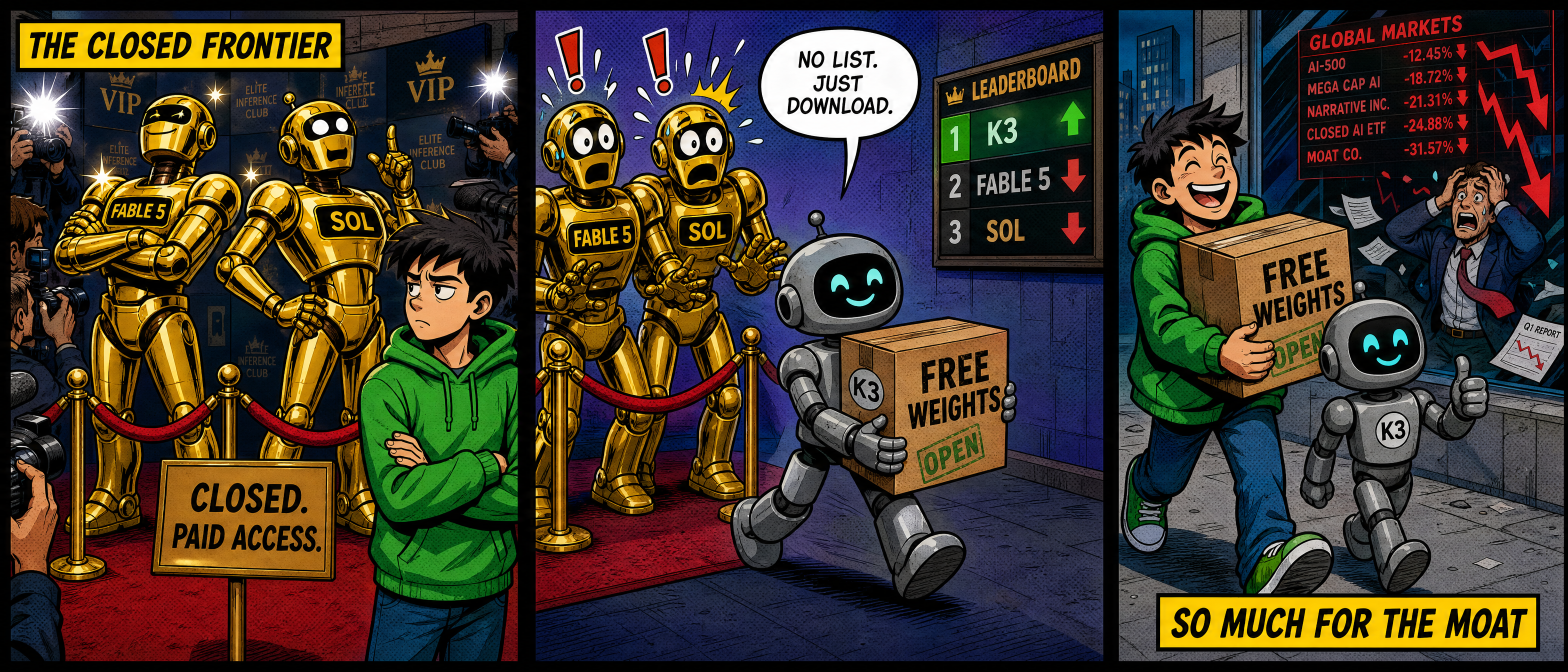
On the Frontend Code Arena leaderboard it took first place, scoring 1,679 against 1,631 for Fable 5 and 1,618 for GPT-5.6 Sol, and it topped six of seven categories. It leads the field outright on SWE Marathon and Program Bench. On Terminal-Bench 2.1 it lands at 88.3, half a point behind Sol. This is not a model creeping up the table. It is a model sitting on top of the coding board, above the best that Anthropic and OpenAI have shipped.
So the honest sentence is narrower than "Kimi beats Fable," and somehow that narrower sentence is the more alarming one. The gap didn't close everywhere. It inverted on the exact axis the entire industry has been using to justify the spend.
The number that isn't a benchmark
Here's the part that matters more than any leaderboard, and it's got nothing to do with a score.
The weights are open. Modified MIT, full public release on July 27. Download it, run it, ship on it, pay Moonshot nothing. It is, by parameter count, the largest open-weight model anyone has ever put out.
Two weeks ago I wrote about GPT-5.6 Sol and the fact that you need Washington's permission to touch it. A frontier model gated behind a government-approved partner list, about twenty names long, none of them yours or mine. I stand by every word of that post, and this week drew the contrast for me sharper than I could have.
One of these models comes with a bouncer who works for the US government. The other one comes with a download link.
And the one with the download link is the one that just topped the coding leaderboard. If you were designing a single week of news to make the case for open weights, you could not do better than the one we just had. The closed frontier put up a velvet rope. The open frontier put up a torrent.
The asterisk nobody says out loud
Now let me deflate my own excitement a little, because there's a catch and it's the same catch I keep writing about.
"Download it and pay nobody" is technically true and practically a fantasy for almost everyone. Kimi K3 is 2.8 trillion parameters. Moonshot's own guidance is 64 or more accelerators just to serve the thing. You are not running this on your MacBook, or your gaming rig, or a single rented GPU. "Open" here means the weights are free, not that the compute is.
So for a normal developer, "open weights" cashes out as: somebody else hosts it, and you call their API. Which is exactly the thing I keep banging on about with European software. Open source is not the same as usable. It needs the boring managed layer on top, the provider who eats the 64 accelerators so you can just point a base URL at it and go.
The good news is that layer is showing up. The moment weights this good drop under a permissive licence, hosts race to serve them, and a European provider like Melious can stand it up on European hardware inside days. That is the actual sovereignty win hiding in this story. Not that you personally will run Kimi K3, you won't. That the best coding model this week is a thing any host on any continent is allowed to serve, with nobody's approval required.
I got the geography wrong
Time for the bit where I admit I called it wrong, because I did.
A few weeks back I wrote a fairly hopeful post about Europe finally funding a frontier model, and underneath it I had a quiet assumption I never quite said out loud: that when a genuinely open model finally cracked the frontier, it would come out of the West somewhere. Europe if we were lucky, America if we weren't. Some lab that shared my rough half of the map.
It came from Moonshot. It came from China. (Named, apparently, with a nod to Pink Floyd, which is a detail I refuse to let go of.) The open answer to closed American AI is not European and it is not American. That should sit slightly uncomfortably with everyone in the European sovereignty conversation, me included, because we have spent two years talking about open weights as our escape hatch, and the group that actually shipped the best open weights this year does not share our jurisdiction, our values, or our alliances either.
An open model you can run without asking permission is a genuinely good thing. An open model whose provenance you also have to think hard about is a more complicated good thing. Both are true this week, and pretending only the first one is true would be exactly the kind of comfortable story I keep warning myself off.
So much for the moat
The whole edifice, the hundreds of billions in data centers, the DeepSeek-sized market shudder that hit on Friday, all of it rests on one assumption. That frontier capability stays scarce, stays expensive, and stays behind a login you pay for.
A free model at the top of the coding board is a direct argument against that assumption, and the market read it that way instantly. Nvidia slipped, the AI names sold off, and everyone dusted off the word "moat" to argue about whether there ever was one.
I don't think the moat was ever the model. The weights leak, the techniques get copied, the gap between best-closed and best-open has been collapsing in months not years for a while now. The moat, if there is one, is the boring stuff. The harness, the tools, the reliability, the way Fable still just feels better on the tasks that don't reduce to a benchmark. That's real, and it's worth money, and it is a much thinner thing to defend than "we have the only good model."
Where that leaves my week
I've still got Fable open in one window. It's better at the vague, underspecified, read-my-mind work, and I'll keep paying for it as long as that stays true, which might not be very long.
But the refactor I ran on Thursday, the boring, well-specified, this-is-just-work kind of task that is most of what I actually do? Kimi K3 did it, in one pass, for a fraction of the price, from a model I'll be able to hold a copy of on the 27th.
The thing I would have bet money stays closed the longest was coding. It's the most valuable, the most defended, the one with the biggest RL and tooling investment poured into it. It's the first wall to come down. I'm going to be watching very closely what actually lands when those weights go public, and whether "trails on user experience" still reads as a comfortable gap by the time K4 shows up, or whether that was this quarter's version of the thing we say right before it stops being true.