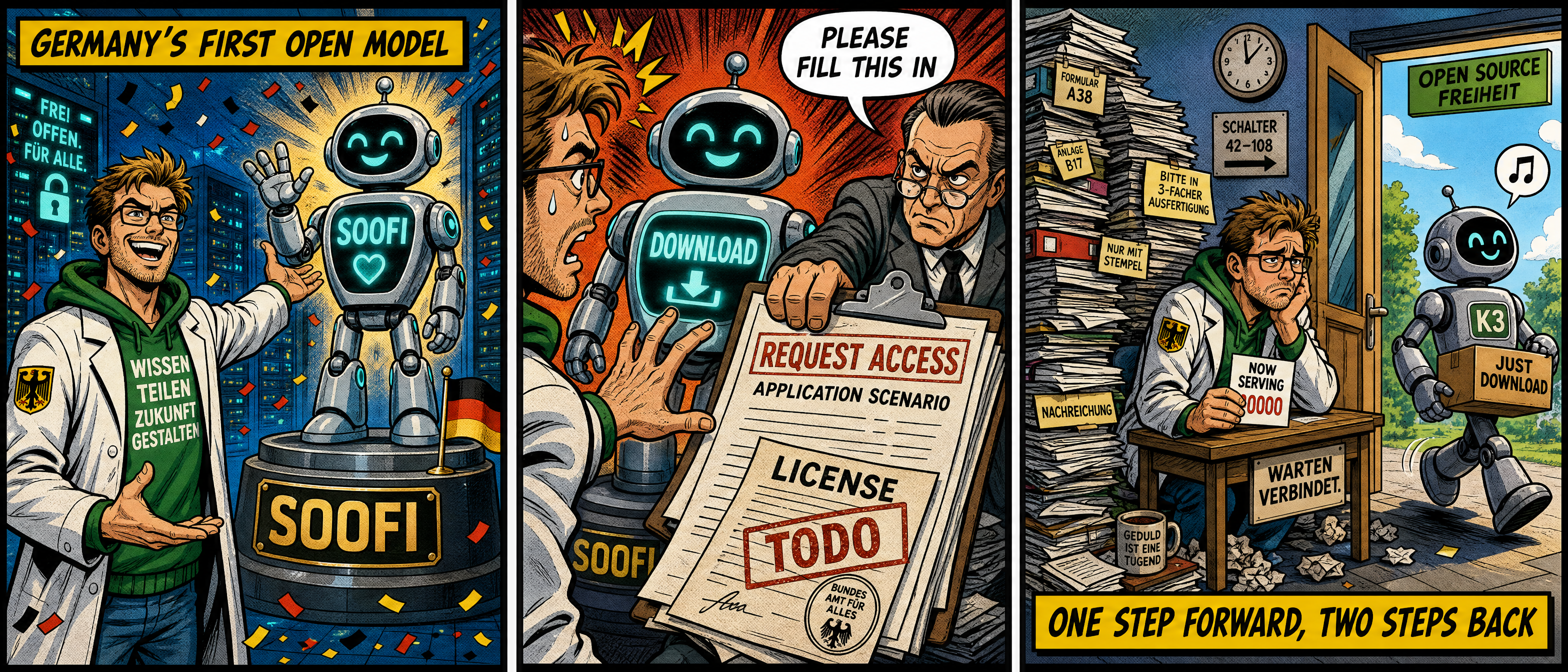
On Wednesday I went to download the first sovereign German open-source model, and it asked me for my contact details first.
Let that sit for a second. The open one. The sovereign one. The one whose entire pitch is that it belongs to Europe and not to some login-walled American lab. I clicked the download link and got a gate asking who I am and, if I wanted it for anything real, what my "application scenario" is.
I laughed, then I got a bit sad, then I wrote this. Because Soofi S is genuinely a good thing, and we still managed to bolt a form to the front of it.
The step forward is real, and I called for exactly this
I want to be fair before I get grumpy, because the achievement here is not small.
Soofi S is a 31.6 billion parameter model, a hybrid Mamba-Transformer mixture-of-experts with about 3.2 billion parameters active per token, a context window stretched to a million tokens. It was built by an actual German consortium, coordinated by the KI Bundesverband, with Fraunhofer, the DFKI, TU Darmstadt and a pile of other institutes involved, and funded by the federal economics ministry. And it was trained end to end on up to 512 Nvidia B200s in Deutsche Telekom's Industrial AI Cloud in Munich.
That last part gave me an actual jolt. Last week I wrote a cautiously hopeful post about those 10,000 GPUs in Munich and wondered aloud what would actually get built in that shed versus just announced in front of it. Here is the answer, arriving faster than I expected: Germany trained its first sovereign foundation model on its own new iron. On the exact machine I was hedging about.
And the thing is good. It tops the open-model field on the German benchmarks, 92.3 on ARC-Challenge-DE, 88.8 on GLP-DE, solid on code with 73.8 percent on HumanEval. For a first model, from a consortium, in German first, that is a properly respectable result. I was ready to write a happy post.
It's also more open than it needed to be
Here's the part that makes the rest genuinely frustrating rather than just funny.
Soofi's ambition is the most open thing in this entire run of posts. Most "open" models dump a bag of weights and hide everything that made them. Soofi's team committed to releasing the weights, the intermediate checkpoints, the full training and evaluation code, and a detailed data inventory, and they say about 99 percent of the training mix can be independently reconstructed, aiming at the Open Source Initiative's actual Open Source AI Definition.
That is not the Kimi model of open, and it is definitely not the Llama model of open. That is the real thing, the reproducible, inspect-the-whole-pipeline kind of open that the open-source community has been asking labs for and almost never gets. In its bones, Soofi is the most honest open model anyone in Europe has shipped.
Which is exactly why the next part is such a waste.
Now the two steps back
The intent is gold standard. The thing you can actually touch this week is a preview behind a clipboard.
The Hugging Face download is gated, you hand over your contact information to get the preview checkpoints. If you want it for production, that runs through the consortium, case by case, with your use case attached, because general release for direct use hasn't happened yet. The licence field on the model card literally reads "Other," with the full text still marked as to-be-added, and the write-up carries the wonderful warning: do not infer rights from the project name. So you cannot even assume you're allowed to use it commercially, because nobody has finished writing down whether you are. The safety fields, the privacy fields, the evaluation section, the release date, all still blank.
They shipped a sovereign open model with the openness marked TODO.
We reinvented the velvet rope, in triplicate
This is where it gets almost too on the nose for me, given the last two weeks.
I spent a whole post being angry at OpenAI for gating its best model behind an approved-partner list, the one where the US government signs off on who gets in. Then I wrote a fairly delighted post about Kimi K3, where the entire punchline was "no list, just download." Type a command, get the weights, ask nobody.
Germany's answer to that, one week later: yes list, but ours is a form, and a person reads it.
Here's the difference that actually matters, though, and it's not flattering to us. OpenAI gates its model because a government leaned on it and there's a real, if debatable, national-security argument. That's an external force. Nobody leaned on the Soofi consortium. No minister demanded an application-scenario field. We did this to ourselves, from instinct, because somewhere deep in the German engineering soul a thing cannot simply be placed on the internet. It must be accompanied. There must be an Antrag. (I'm allowed to say this. I have filled in the Formular for the Formular.)
The Americans built a gate because they were told to. We built one because we couldn't help it.
The whole European problem, in one download button
Put the two side by side, from the same fortnight.
Kimi K3: 2.8 trillion parameters, tops the coding board, and you get it by typing a line into a terminal. Soofi S: a genuinely, deeply, reproducibly open model, more open in principle than Kimi will ever be, and you get it by submitting your details and waiting for a human to consider your scenario.
Guess which one gets adopted. It isn't the one with the cleaner data inventory. It's the one you can be using before lunch without talking to anyone. This is the same thing I keep writing about the free tier and the missing on-ramp, just wearing a lab coat instead of a startup hoodie. Openness that requires a conversation is not openness a busy team will ever reach for. It's a research artefact with good manners.
And that hurts more here than usual, because the German model deserves better than its own front door. The team did the genuinely hard part, the training, the reproducibility, the German-language quality, on European hardware, at a level nobody handed them. Then they lost the easy part, the part that is just "put the file somewhere and let people take it," to the reflex that has cost us a decade of software.
Where that leaves me
I'm going to request access. I actually want to run it, the German-language numbers are good, and I'm rooting for this consortium in a way I don't root for OpenAI.
But notice that "I'm going to request access" is a sentence I just wrote about an open-source model, and sit with how absurd that is. The Munich machine did precisely what I hoped it would, faster than I thought. The model is real and the openness is, on paper, best in class. The only thing standing between Soofi and the developers who'd champion it is a form nobody needed to build.
Finish the licence. Ungate the download. Delete the application-scenario field. The hard part is behind you and you nailed it. Please, for once, don't lose on the easy part.