In my last post I wrote about DevRel being invisible in the boardroom. Nobody upstairs could see the work, so the budget kept moving somewhere with cleaner numbers. That's still true. But now that Smoower is actually scanning companies at scale, a second kind of invisibility has jumped out at me, and it's arguably more urgent.
More than 500 companies in the index have not done the absolute minimum necessary things to be visible to AI.
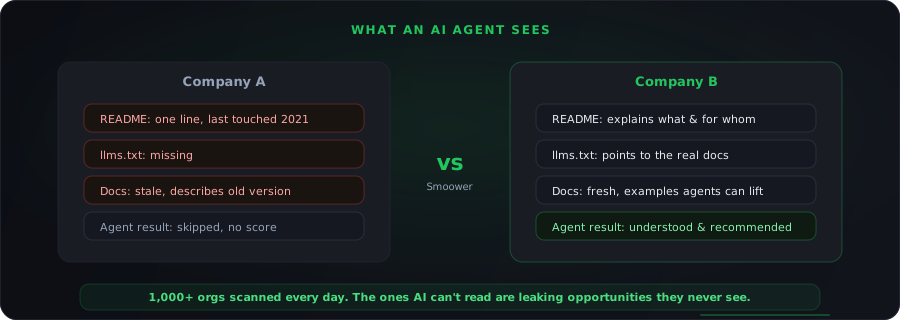
Not invisible to people. Their site loads, their product works, real humans use it. But the moment an AI agent goes looking for them, there's nothing there. No README worth reading. No llms.txt. No machine-legible description of what they build, who it's for, or how to use it. An agent shows up, finds a marketing page and a repo with a one-line README from 2021, and moves on to a competitor it can actually understand.
Google Chrome's lighthouse now scans for LLMS.txt, an addition that makes clear this is something important everyone should do.
What "invisible to AI" actually means
Discovery is being quietly rewired. A growing share of "how do I do X" no longer ends at a search results page. It ends inside Claude Code, Cursor, Copilot, or some agent a developer wired up themselves. The developer never sees your homepage. The agent does the reading, and the agent decides what gets recommended, imported, and built on.
So the question stops being "does this look good to a human skimming for ten seconds" and becomes "can a model, with no prior context, figure out what you do and how to use it from your public surface alone."
For a huge number of companies the honest answer is no. The signals an agent leans on barely exist:
- A README that explains the project instead of just listing install commands
- An
llms.txtthat points an agent at the docs that actually matter - Docs that are current rather than describing a version from two years ago
- Examples an agent can lift and adapt without guessing
When those are missing, you don't get a low score. You get no score. You're not in the conversation the agent is having with the developer at all. And the brutal part is that the company has no idea it's happening, because nothing breaks. There's no 404, no error, no angry tweet. There's just a slow leak of opportunities to whoever wrote the better README.
Now with Smoower, seeing how many that actually are is kinda scary not gonna lie!
This is the same problem wearing a new costume
I keep coming back to the same root cause. DevRel's whole job is to make a company legible to developers, and we've never had a way to see how well anyone actually does it. For years that invisibility cost teams their budgets. Now it costs companies their place in an agent's recommendation. Same gap, higher stakes, faster feedback loop.
What changed is who's reading. The audience used to be a developer with patience and a search bar. Increasingly it's a model with a token budget and a dozen other tabs open. Models are unforgiving readers. They don't squint past a stale doc out of brand loyalty. If the surface is thin, they route around it.
If you're looking for a Mailservice in Claude, you get Resend suggested first, not because they are particually good but they where there at the right time at the right place and now Claude sees it every day in other people's code and keeps suggesting it.
You can have the best product in your category and still lose to a worse one that wrote a README an agent could understand. That's the new game, and most companies don't know they're playing it.
What Smoower does about it
This is exactly the thing Smoower is built to surface, and it splits cleanly into two jobs.
Educate. A lot of leadership teams genuinely don't know what an AI agent sees when it looks at them. So we show them. Here's your public surface the way a model encounters it. Here's where it goes blank. Here's the llms.txt you don't have and the README that says nothing. Most of the time the fix is not expensive, it's just nobody's job, and you can't prioritise a problem you can't see.
Compare and showcase. An isolated score is easy to dismiss. A score next to your peers is not. Smoower indexes across companies, so you can see who in your category is doing this well, which sectors are pulling ahead, and which branches of the industry are quietly far better at being legible than others. Some categories are surprisingly mature. Others, including ones you'd assume are sophisticated, are wide open. Showing the leaders does double duty: it gives everyone else a concrete target, and it gives the teams doing good work the public credit they almost never get internally.
The point isn't to grade people. It's to make the invisible visible, for boards and for bots at the same time.
Why we're adding a supporter program instead of ads
Here's the part I've been chewing on. Running this isn't free. Smoower scans more than a thousand orgs every single day, and a lot of that work is LLM inference, because reading a docs page and judging whether it's fresh, or telling real technical depth apart from a press release in seven fonts, is exactly the thing only a model can do at this scale. That's the whole reason the index can exist now. It's also a real, recurring cost that doesn't go down when traffic goes up.
The obvious way to cover that is ads. I'm not going to do that.
Ads on a DevRel index are counter to the entire point. The credibility of a benchmark is the product. The second you can pay to look better, or pay to sit next to the companies that earned their spot, the score means nothing and you've rebuilt the exact problem we're trying to kill. So instead we're adding a supporter program: a straightforward way for people and companies who want this thing to exist to help fund the inference behind it, without buying influence over the results. Support keeps the lights on and the scans running. It doesn't move your number. That separation is the point.
Scanning a thousand-plus orgs a day is not cheap. It is, I'm convinced, worth it, because a healthier, more legible DevRel market helps everyone in it, and because being readable by AI coding agents is rapidly becoming table stakes rather than a nice-to-have.
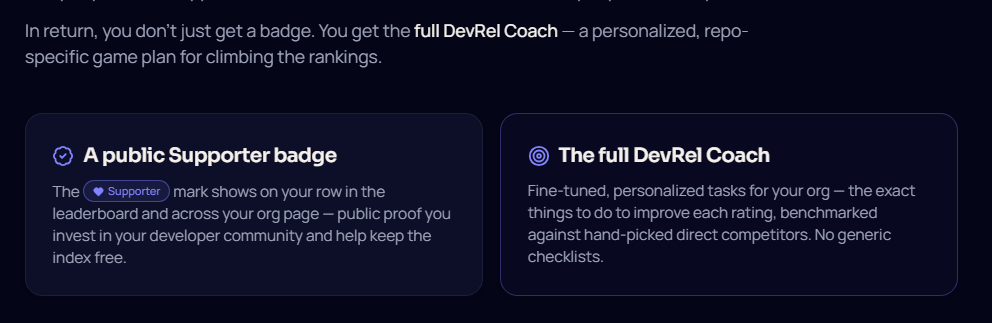
And then, the coach
Measurement tells you where you stand. It doesn't fix anything on its own. The next thing on the roadmap is a DevRel coach: instead of just handing you a score and a peer comparison, it tells you what to actually do about it. Personalized, alongside your own docs, github and more. It tells you exactly what to fix, suggests blog posts or videos, tells you what examples might help users and a whole lot more. The index makes the problem legible; the coach helps you close it.
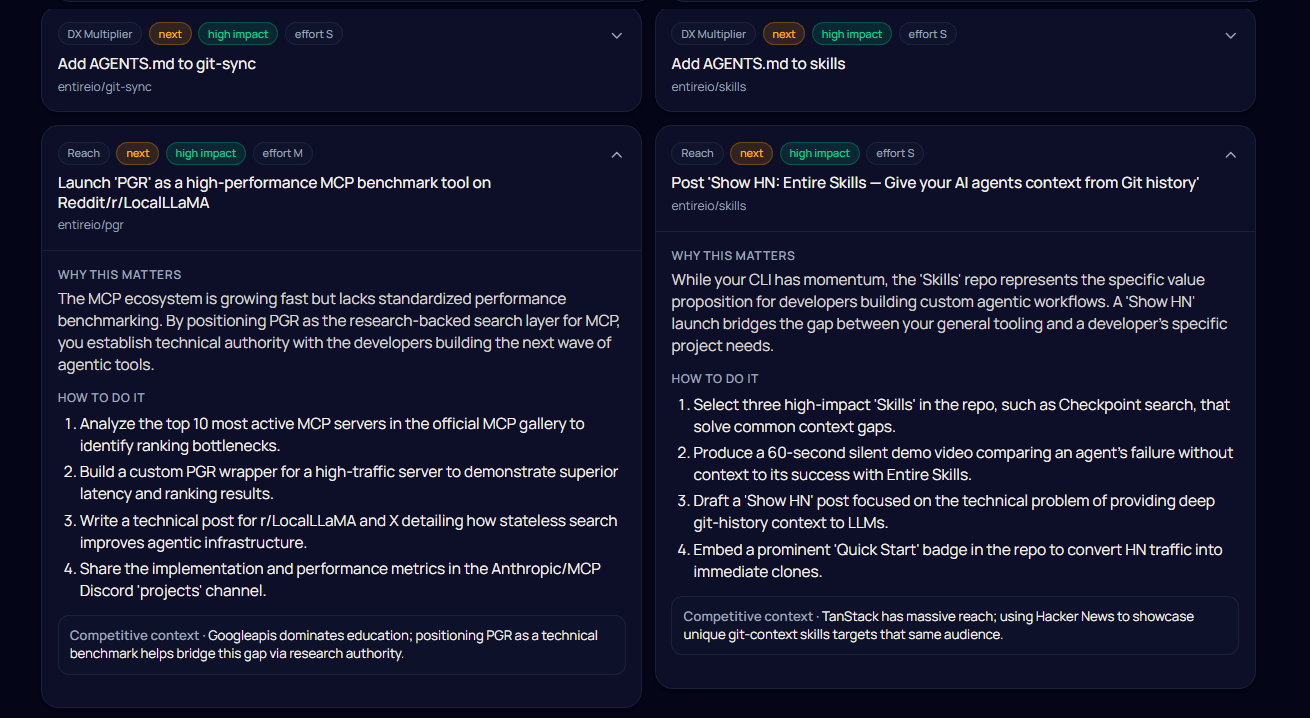
That's still ahead of us, and I'd rather show the plan than oversell it. If you want to see where this is going, the Smoower roadmap is public and reasonably honest about what's shipped, what's in progress, and what's still an idea.
So, two asks. Go look at Smoower, find your company, and see what an agent sees when it looks at you. You might be surprised how much of your surface comes back blank. And if you think a credible, ad-free DevRel index is worth having around, the supporter program is how you help keep it scanning.
I'll write more about the methodology soon, like I keep promising.